RST CTI Assistant for MS Teams
RST CTI Assistant for MS Teams
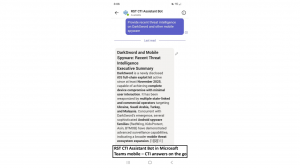
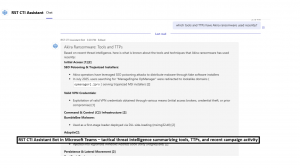
RST Cloud's artificial intelligence threat intelligence advisor, known as RST CTI Assistant, is now operational as a bot within Microsoft Teams.
Security operations center analysts don't stop working at 5pm, and their access to threat intelligence should be just as constant. They no longer have to wait for a teammate – they can ask a question and receive a source-traceable answer, directly inside MS Teams.”— Alex Gould, CTI Strategist, RST Cloud
SYDNEY, NSW, AUSTRALIA, October 5, 2026 /EINPresswire.com/ — RST CTI Assistant, the AI-driven threat intelligence advisor from RST Cloud, has become available as a bot integrated into Microsoft Teams. Threat intelligence delivers the most value where security teams are already located – and for the majority of teams, that is a Teams channel rather than a separate portal or a tab they must remember to open.
SOC analysts operate around the clock. Their CTI team, if one exists at all, generally does not – standard coverage is 8×5, and many organizations function without any dedicated threat intelligence unit. RST CTI Assistant bridges this gap: it offers a conversational method for investigating threats that is accessible whenever a query arises, without departing from the current workflow.
INQUIRE ABOUT:
✓ The threat environment: What dangers are currently focusing on your industry, region, or sector?
✓ Threat actors & malware: Which groups are responsible, what are their skills, and what methods do they employ?
✓ TTPs & campaigns: Which techniques are presently in use, and what should your team monitor for next?
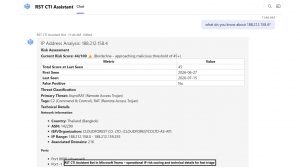
✓ Indicators: What details exist for a given IP, domain, or hash – along with the source attribution?
By default, RST CTI Assistant is offered as an API, allowing organizations the adaptability to embed threat intelligence straight into their current security tools, platforms, and processes. The Teams bot introduces a secondary, conversational interface on top of the identical engine – fueled by RST Cloud's threat intelligence, research, enrichment data, and knowledge bases, employing multi-agent RAG to deliver source-cited answers directly into the chat. Each response is traceable back to the original report it used, enabling an analyst to confirm a claim as effortlessly as they posed the question.
WHY IT IS SIGNIFICANT FOR SECOPS TEAMS:
A question raised outside the workflow is a question that frequently never gets asked. By embedding a threat intelligence advisor directly into Teams, RST Cloud eliminates the barrier between having a question and obtaining a cited answer – no separate login, no context shift, no reliance on an 8×5 CTI unit or a colleague who might be offline. For SecOps professionals and security executives, this transforms occasional lookups into a routine practice and converts a knowledge repository into a resource the entire team actively employs.
RST CTI Assistant for Microsoft Teams is currently accessible on the Microsoft Marketplace, in addition to the current API integration for teams seeking to incorporate it into their own tools and dashboards.
Microsoft Teams app:
marketplace.microsoft.com/en-us/product/wa200011507
Website: rstcloud.com
Trial inquiries: trial@rstcloud.com
ABOUT RST CLOUD
RST Cloud develops practical cyber threat intelligence for agents, supplying machine-readable threat feeds, IoC lookups, noise reduction, and compromised-credential intelligence via a unified API-first layer into any SOC workflow. RST CTI Assistant is a component of that layer, pairing RST Cloud's research and knowledge bases with multi-agent RAG so that SecOps teams obtain sourced answers wherever they already operate.
RST CLOUD PTY LTD
RST Cloud
email us here
Visit us on social media:
LinkedIn
Facebook
YouTube
X
Other