The Business Research Company

The Business Research Company’s Network And Software Infrastructure Global Market Report 2026 – Market Size, Trends, And Forecast 2026-2035
Growth in the network and software infrastructure sector has been notable, driven by improvements in connectivity and the evolution of urban technology. As municipalities increasingly depend on intelligent systems and data-centered operations, this industry is anticipated to expand steadily over the coming years. Let’s examine the present market valuation, primary growth drivers, regional breakdowns, and what lies ahead for this essential field.
Network and Software Infrastructure Market Size and Growth Forecast Through 2026
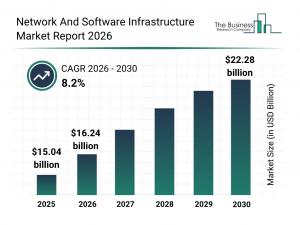
The network and software infrastructure market has witnessed robust recent growth, climbing from $15.04 billion in 2025 to an estimated $16.24 billion in 2026, reflecting a compound annual growth rate (CAGR) of 8.0%. This past expansion has been underpinned by the spread of urban broadband and fiber optic networks, early-stage IoT sensor deployments in city settings, substantial governmental funding for smart city projects, the rollout of 4G networks to enhance connectivity, and the rising volume of data center construction.
Download a free sample of the network and software infrastructure market report:
https://thebusinessresearchcompany.com/sample_request?id=35863634&type=smp&name=Network%20And%20Software%20Infrastructure%20Market%20Report%202026&utm_source=EINPresswire&utm_medium=Paid&utm_campaign=Oct_PR
Going forward, the market is positioned for sustained strong growth, forecasted to hit $22.28 billion by 2030, at a marginally higher CAGR of 8.2%. This anticipated increase is fueled by multiple elements, including the uptake of standalone 5G and forthcoming 6G technologies in city areas, broad integration of edge computing into municipal infrastructure, autonomous mobility solutions, growing need for real-time urban analytics and automation, and modernization initiatives focusing on cyber resilience and secure systems. Prominent trends shaping the sector involve edge-native distributed computing frameworks for metropolitan settings, software-defined networking for city-wide traffic management, interoperable data exchange platforms enabling cross-agency coordination, adoption of zero-trust network security models within smart city systems, and hybrid cloud-edge integration facilitating real-time municipal service delivery.
Understanding Network and Software Infrastructure and Its Role in Smart Cities
Network and software infrastructure encompasses the combined hardware, software, and networking technologies that enable connectivity, data management, application deployment, and communication within smart city contexts. This integrated framework supports efficient information sharing, continuous monitoring, data analysis, and automation across urban IoT devices and information and communication technology (ICT) platforms. Consequently, it boosts operational efficiency, improves resource management, and enhances service delivery to residents.
View the full network and software infrastructure market report:
https://thebusinessresearchcompany.com/report/network-and-software-infrastructure-market-report?utm_source=EINPresswire&utm_medium=Paid&utm_campaign=Oct_PR
Factors Propelling the Network and Software Infrastructure Market Forward
A key driver accelerating this market’s expansion is the increase in mobile data traffic. This term refers to the volume of data transmitted through wireless networks via mobile devices, covering activities such as web browsing, video streaming, and app usage. The surge in mobile data traffic stems largely from the growing use of high-bandwidth applications like streaming services and cloud computing, which significantly boost data consumption on mobile networks. Network and software infrastructure solutions are essential for managing this growth by enhancing connectivity, expanding capacity, routing data efficiently, and maintaining reliable high-speed network performance.
Reinforcing this trend, Ericsson AB, a prominent telecommunications and networking technology firm headquartered in Sweden, projected in November 2025 that the proportion of mobile data traffic carried over 5G networks would rise from 34% at the end of 2024 to 43% by late 2025, eventually reaching 83% by 2031. This rapid global adoption and transition toward 5G networks strongly fuels the increasing demand for network and software infrastructure technologies.
Regional Overview of the Network and Software Infrastructure Market
Regarding regional market share, North America claimed the largest position in 2025 within the network and software infrastructure sector. Nevertheless, the Asia-Pacific region is predicted to see the fastest growth during the forecast period. The market report delivers thorough coverage of key geographic regions, including Asia-Pacific, South East Asia, Western Europe, Eastern Europe, North America, South America, the Middle East, and Africa, offering a wide view of global market trends.
Our 2026 market reports now provide broader strategic coverage through market attractiveness scoring and analysis, total addressable market (TAM) analysis, company scoring matrix graphics and tables, Excel-based forecasting dashboards, market hotspots infographics, key technologies and future trend analysis, along with updated graphics and tables.
Speak With Our Expert:
Saumya Sahay
Americas +1 310-496-7795
Asia +44 7882 955267 & +91 8897263534
Europe +44 7882 955267
Email: marketing@tbrc.info
The Business Research Company – www.thebusinessresearchcompany.com
Follow Us On:
• LinkedIn: https://in.linkedin.com/company/the-business-research-company
Oliver Guirdham
The Business Research Company
7882 955267
Visit us on social media:
LinkedIn
Facebook
X