If you’ve streamed a video, joined a video call, or accessed cloud storage today, you’ve relied on the tiny but mighty components at the heart of our digital world: fiber optic connectors. As data centers expand and 5G networks roll out globally, this niche hardware segment is poised for steady, multi-billion-dollar growth over the next several years.
Fiber Reinforced Plastic Vessels Market
The Business Research Company’s Fiber Optic Connectors Global Market Report 2026 – Market Size, Trends, And Forecast 2026-2035
LONDON, GREATER LONDON, UNITED KINGDOM, October 8, 2026 /EINPresswire.com/ — The fiber optic connectors market is on track for notable expansion as digital technology and communication infrastructure evolve at a rapid pace. As a critical component of the wider communications hardware industry, these connectors play an essential role in enabling fast, efficient, and dependable data transmission across diverse networks. Here’s a closer look at the market’s current position, growth engines, leading segments, regional trends, competitive forces, and what lies ahead.
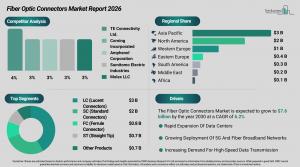
Market projections indicate the fiber optic connectors sector will surpass $8 billion by 2030. While this represents a modest slice of the broader Communications Hardware market—expected to hit nearly $1,026 billion that same year, with connectors making up roughly 1%—it’s a vital piece of the puzzle. Within the expansive Information Technology industry, projected at $13,788 billion by 2030, fiber optic connectors account for about 0.1% of overall value.
Request A Free Sample Of The Fiber Optic Connectors Market Report
https://thebusinessresearchcompany.com/sample_request?id=86638424&type=smp&name=Fiber%20Optic%20Connectors%20Market%20Report%202026&utm_source=EINPresswire&utm_medium=Paid&utm_campaign=Oct_PR
One of the biggest tailwinds for the fiber optic connectors market is the explosive growth of data centers. With cloud computing, artificial intelligence, and digital services surging, companies are pouring money into advanced fiber infrastructure. These connectors deliver the low-loss, high-speed, and reliable links needed between servers, storage systems, and networking gear—making them indispensable to modern data center architecture. This trend alone is projected to fuel about 2.2% annual growth.
Another key driver is the rapid rollout of 5G and fiber broadband networks. The extensive fiber backhaul and fronthaul required for 5G, combined with expanding fiber-to-the-home (FTTH) projects, is driving demand for dependable optical connectors across telecom networks. This factor is estimated to contribute 2.0% annual growth.
Access The Detailed Fiber Optic Connectors Market Report Here
https://thebusinessresearchcompany.com/report/fiber-optic-connectors-global-market-report?utm_source=EINPresswire&utm_medium=Paid&utm_campaign=Oct_PR
The push for high-speed data transmission is also a major factor. Compared to copper, fiber optic connectors offer higher bandwidth and lower signal loss, making them attractive to sectors like healthcare, banking, manufacturing, transportation, and defense as they modernize their communication systems. This driver adds approximately 1.7% annual growth.
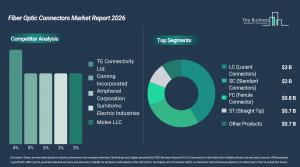
When it comes to product types—SC (standard connectors), LC (lucent connectors), FC (ferrule connector), ST (straight tip), MXC connector, and others—the LC segment is expected to lead in 2030. Forecast to hold 37% of the market, or roughly $3 billion, LC connectors are favored for their compact size and high-density fiber connectivity. Their appeal is strengthened by data center cable management needs, enterprise networking applications, and ongoing improvements that boost signal quality and installation flexibility.
The market is also segmented by cable type—simplex, duplex, and multi-fiber—and by application, spanning telecommunication, inter- or intra-building connections, community antenna television, data centers, high-density interconnection, security systems, and more.
Geographically, Asia Pacific is projected to be the largest regional market by 2030, with a valuation of $3.1 billion, up from $2.3 billion in 2025 at a 6% CAGR. This growth is underpinned by rapid broadband infrastructure buildout, increased fiber network investments in emerging economies, next-gen telecom advances, and a growing need for high-bandwidth, reliable connectivity to support digital transformation.
The United States is forecast to lead as the top national market in 2030, valued at $1.5 billion, rising from $1.2 billion in 2025 at a 5% CAGR. Growth there is driven by FTTH deployments, hyperscale data center investments, enterprise adoption of high-speed technology, and telecom infrastructure upgrades to handle rising data traffic.
Global manufacturers of optical networking equipment and connectivity solutions dominate this space. They focus on high-performance designs, cutting-edge transmission technologies, miniaturization, and enhanced reliability for telecom, data center, and industrial applications. As bandwidth demand climbs and fiber networks expand, companies are leaning on innovation and strategic partnerships to stay competitive.
TE Connectivity Ltd. was the market leader in 2025 with a 4% share. Its communications solutions division provides a wide array of fiber optic connectivity products and high-speed interconnect solutions for telecom infrastructure, data centers, enterprise networks, and industrial communications.
The market is moderately fragmented, with the top 10 players holding 23% of total revenue in 2025. High performance standards, precision manufacturing, compatibility demands, and engineering complexity create entry barriers. Leading firms maintain strong positions through diversified portfolios, partnerships with network providers, global distribution, and continuous innovation. Collaboration and regional strategies will be key as demand for high-speed transmission and expanded fiber networks grows.
The top companies and their 2025 market shares include:
– TE Connectivity Ltd. (4%)
– Corning Incorporated (3%)
– Amphenol Corporation (3%)
– Sumitomo Electric Industries (3%)
– Molex LLC (3%)
– Furukawa Electric Co. Ltd. (3%)
– US Conec Ltd. (2%)
– AFL Telecommunications LLC (1%)
– HUBER+SUHNER AG (1%)
– The Siemon Company (0.1%)
Field-installable fiber optic connector systems are changing the game by cutting installation times and boosting deployment efficiency, speeding up broadband rollouts. For instance, in May 2025, Corning Incorporated launched its Evolv Field Installable Pushlok connector system. This product simplifies fiber terminations without fusion splicing, supports hardened subscriber drop cables, and requires fewer tools—improving operational efficiency, especially in rural or hard-to-reach locations.
All six product segments are expected to contribute significantly to growth, adding more than $2.7 billion by 2030. Between 2025 and 2030, SC and LC connectors are each forecast to grow by $1 billion, FC and ST connectors by $0.2 billion each, MXC connectors by $0.1 billion, and other products by $0.2 billion. This expansion is fueled by fiber broadband rollouts, hyperscale data center investments, 5G and FTTH infrastructure, and the persistent need for low-loss, high-density connectivity as telecom networks evolve.
Key competitive tactics include advancing connector technologies for better data transmission, optimizing designs for faster and more reliable installation, expanding fiber infrastructure for broadband and data networks, and adopting advanced manufacturing methods to improve precision and efficiency.
Prominent companies in this space include TE Connectivity Ltd., Corning Incorporated, Amphenol Corporation, Sumitomo Electric Industries, Molex LLC, Furukawa Electric Co. Ltd., US Conec Ltd., AFL Telecommunications LLC, HUBER+SUHNER AG, The Siemon Company, Phoenix Contact GmbH & Co. KG, SENKO Advanced Components, Broadcom Inc., Panduit Corporation, Samtec, Inc., 3M Company, Radiall SA, Rosenberger Group, OFS Fitel LLC, Hirose Electric Co. Ltd., Diamond SA, and L-com Global Connectivity.
Raw materials for fiber optic connectors come from suppliers like Corning Incorporated, Sumitomo Electric Industries Ltd., Prysmian Group, Furukawa Electric Co., Ltd., and others. Distributors such as Digi-Key Electronics, Mouser Electronics, Arrow Electronics, Avnet, RS Group, and Ingram Micro serve as key intermediaries. End users include major tech and telecom firms like Cisco Systems, Nokia, Ericsson, Huawei, ZTE, Ciena, Juniper Networks, Arista Networks, CommScope, ADTRAN, Broadcom, Dell Technologies, Hewlett Packard Enterprise, IBM, Oracle, Microsoft, Amazon Web Services, Google, Verizon, AT&T, Deutsche Telekom, NTT Communications, Lumen Technologies, Orange, and Vodafone.
What’s new in our 2026 market reports:
• Market attractiveness scoring and analysis
• Total addressable market (TAM) analysis
• Company scoring matrix graphics and tables
• Excel dashboards
• Market hotspots infographics
• Key technologies and future trends
• Updated graphics and tables
About The Business Research Company
The Business Research Company (www.thebusinessresearchcompany.com) is a well-known market intelligence firm specializing in company, market, and consumer research. With over 30,000+ reports spanning 27 industries and more than 60 geographies, their insights draw on 1.5 million datasets, extensive secondary research, and interviews with industry leaders. They offer tailored research packages including Market Entry, Competitor Tracking, and Supplier & Distributor services.
Disclaimer: The information provided by TBRC Business Research Pvt Ltd is gathered in good faith from primary and secondary sources, though accuracy cannot be fully guaranteed. The company disclaims liability for any actions taken based on its findings, which are intended as estimates and opinions rather than definitive facts or investment advice.
Contact Information
The Business Research Company
Americas: +1 310-496-7795
Europe: +44 7882 955267
Asia & Others: +44 7882 955267 / +91 8897263534
Email: marketing@tbrc.info
Follow on LinkedIn: https://in.linkedin.com/company/the-business-research-company
Oliver Guirdham
The Business Research Company
+44 7882 955267
Visit us on social media:
LinkedIn
Facebook
X
Why it matters: As the backbone of modern connectivity, fiber optic connectors underpin everything from data center operations to 5G expansion. The market’s steady growth signals sustained investment in the infrastructure that powers digital services, cloud computing, and next-generation networks—making it a key indicator of broader technological progress.