The pharmaceutical industry is undergoing a quiet revolution, and artificial intelligence is the engine driving it. A new market forecast reveals that AI-powered drug discovery is not just a niche experiment anymore—it is a multi-billion-dollar sector poised to reshape how medicines are developed, with Asia-Pacific emerging as the surprise powerhouse.
The Business Research Company’s Artificial Intelligence in Drug Discovery Global Market Report 2026 – Market Size, Trends, And Forecast 2026-2035
LONDON, GREATER LONDON, UNITED KINGDOM, October 8, 2026 /EINPresswire.com/ — The fusion of artificial intelligence with drug discovery is fundamentally altering the pharmaceutical industry, creating pathways toward faster and more economical drug development. This specialized market is expanding rapidly and now represents a notable slice of the broader AI and technology sectors. Here, we break down its current size, the forces behind its growth, the major players involved, and what lies ahead.
Market Size and Expansion of the Artificial Intelligence in Drug Discovery Market
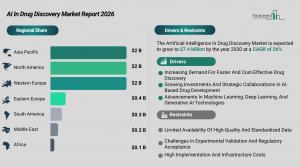
The global market for AI in drug discovery is projected to exceed $7 billion by 2030. While it is a small piece of the larger Artificial Intelligence market—forecast to hit roughly $920 billion in the same timeframe—its impact is outsized. Within the massive Information Technology industry, expected to reach $13,788 billion by 2030, this niche accounts for about 0.1% of the total valuation.
Request A Free Sample Of The Artificial Intelligence In Drug Discovery Market Report
https://thebusinessresearchcompany.com/sample_request?id=79642654&type=smp&name=Artificial%20Intelligence%20%28AI%29%20In%20Drug%20Discovery%20Market%20Report%202026&utm_source=EINPresswire&utm_medium=Paid&utm_campaign=Oct_PR
Growth Trajectory of the Artificial Intelligence in Drug Discovery Market
This market is on a steep upward climb, with a compound annual growth rate (CAGR) of 26% expected through 2030. That pace underscores how quickly pharmaceutical companies and biotech firms are embracing AI-driven solutions to overhaul their research and development pipelines.
Regional Prospects in the Artificial Intelligence in Drug Discovery Market
By 2030, Asia-Pacific is predicted to become the largest regional market, surging to a value of $2.3 billion from $0.6 billion in 2025—a blistering CAGR of 31%. This explosion is fueled by a surge in investments in AI-powered life sciences research, wider adoption of digital drug discovery platforms by pharmaceutical and biotech firms, government initiatives backing biotech innovation, rapid cloud computing development, and deeper collaboration between AI technology companies and regional research institutions.
Access The Detailed Artificial Intelligence In Drug Discovery Market Report Here
https://thebusinessresearchcompany.com/report/Artificial-Intelligence-In-Drug-Discovery-Global-Market-Report?utm_source=EINPresswire&utm_medium=Paid&utm_campaign=Oct_PR
Prominent Country-Level Growth in the Artificial Intelligence in Drug Discovery Market
The United States is forecast to remain the single biggest country market, expanding from $0.8 billion in 2025 to $2.0 billion in 2030 at a CAGR of 20%. That growth is driven by a concentration of leading AI technology providers and major pharmaceutical companies, significant advances in precision medicine and computational biology, the availability of high-quality biomedical data, widespread use of generative AI in drug research, and ongoing partnerships that link biotech firms, research centers, and AI platform developers.
Technology Segmentation Within the Artificial Intelligence in Drug Discovery Market
The market is broken down by technology into context-aware processing, natural language processing (NLP), and deep learning. Among these, natural language processing is expected to dominate by 2030, capturing 43% of the market with a valuation of $3 billion. This trend is supported by applications such as automated mining of scientific literature, biomedical knowledge extraction, faster identification of drug targets, efficient analysis of research and clinical data, and the increased use of AI assistants in drug discovery workflows.
Additional Segments in the Artificial Intelligence in Drug Discovery Market
The market is further segmented by drug type into small molecules and large molecules. Therapeutic categories covered include metabolic diseases, cardiovascular diseases, oncology, neurodegenerative diseases, anti-infective diseases, respiratory diseases, and others. End users range from pharmaceutical companies and biopharmaceutical firms to academic and research institutes, along with other users.
Factors Fueling Growth in the Artificial Intelligence in Drug Discovery Market
One major growth driver is the rising demand for faster and more cost-efficient drug development. Pharmaceutical companies are turning to AI to shorten research timelines, reduce experimental expenses, and more accurately predict potential drug candidates. AI platforms enable rapid analysis of biological and chemical data, improve drug-target predictions, and streamline lead optimization, boosting productivity while minimizing risks. This factor contributes approximately 1.5% to the annual market growth.
Another significant factor is the increase in investments and strategic partnerships in AI-enabled drug development. Companies are collaborating with AI technology providers and biotech firms to enhance computational drug discovery capabilities and accelerate innovation. These alliances merge advanced AI platforms with biological expertise and proprietary data, improving candidate selection and research outcomes. Growing venture funding and industry collaborations also support the commercialization of AI-driven drug discovery, contributing around 1.0% to yearly growth.
Innovations in machine learning, deep learning, and generative AI technologies are also propelling market expansion. These advancements improve the accuracy of predicting molecular behaviors, biological interactions, and therapeutic potential. Additionally, they facilitate the generation and optimization of novel drug candidates, enhancing computational precision and enabling broader AI application across pharmaceutical research. This driver is estimated to add roughly 0.8% growth annually.
Prime Growth Opportunities Within the Artificial Intelligence in Drug Discovery Market
The segments of context-aware processing, natural language processing, and deep learning are expected to offer the largest growth prospects, collectively adding over $6 billion in value by 2030. Between 2025 and 2030, context-aware processing should increase by $1 billion, natural language processing by $3 billion, and deep learning by $2 billion. These gains are driven by AI-powered knowledge extraction tools, sophisticated computational models, rising demand for intelligent molecular prediction, and the integration of AI throughout drug discovery workflows. This reflects the life sciences sector’s focus on accelerating therapeutic innovation, improving research efficiency, and making data-driven decisions.
Competitive Landscape of the Artificial Intelligence in Drug Discovery Market
The market is shaped by three main groups: global technology companies, pharmaceutical software providers, and specialists in AI-driven drug discovery. These players are investing heavily in advanced machine learning algorithms, generative AI platforms, cutting-edge computing infrastructure, predictive molecular modeling, and large-scale biological data analytics. Their competitive edge lies in faster target identification, enhanced drug candidate optimization, higher research productivity, and embedding AI across the complete drug discovery process. A clear understanding of technological advancements and strategic partnerships is crucial for stakeholders seeking growth in this evolving pharmaceutical research ecosystem.
Market Leader in Artificial Intelligence in Drug Discovery
According to The Business Research Company, NVIDIA Corporation led the global market in 2025 with a 6% share. Their high-performance GPUs, AI software, and computing solutions support molecular simulations, protein structure prediction, drug candidate screening, and large-scale biomedical research for pharmaceutical and biotech organizations.
Market Share Distribution Among Top Competitors
The market is moderately fragmented, with the top 10 companies accounting for 23% of total revenue in 2025. While the entry barriers include technological complexity and regulatory compliance, the leading firms hold significant market shares by offering AI-enabled drug discovery platforms, forming strategic pharmaceutical collaborations, and maintaining strong cloud computing and life sciences research capabilities. As demand grows for faster drug development, precision therapeutics, scalable AI platforms, and data-driven research, innovation, partnerships, and enhanced AI capabilities will be key to maintaining competitive advantage.
Leading Companies and Their Market Presence in 2025
Notable players and their market shares include:
– NVIDIA Corporation (6%)
– Microsoft Corporation (3%)
– Alphabet Inc. (2%)
– Novartis AG (2%)
– DeepMind Technologies Limited (2%)
– F. Hoffmann-La Roche Ltd. (2%)
– Johnson & Johnson (2%)
– AstraZeneca PLC (2%)
– Pfizer Inc. (2%)
– Merck & Co., Inc. (1%)
Key Players Operating in the Artificial Intelligence in Drug Discovery Space
Prominent companies active in this market include NVIDIA Corporation, Microsoft Corporation, Alphabet Inc., Novartis AG, DeepMind Technologies Limited, F. Hoffmann-La Roche Ltd., Johnson & Johnson, AstraZeneca PLC, Pfizer Inc., Merck & Co., Inc., Amgen Inc., Takeda Pharmaceutical Company Limited, IBM Corporation, IQVIA Holdings Inc., Insilico Medicine, BenevolentAI, AbbVie Inc., Exscientia, Owkin Inc., XtalPi Inc., Atomwise, Deep Genomics Inc., Galderma S.A., Ipsen S.A., Verge Genomics, GlaxoSmithKline plc, GE HealthCare Technologies Inc., Standigm Inc., Iktos, Cyclica Inc., GNS Healthcare, NuMedii, Innoplexus AG, Adagene Inc., Quris, Gero Pte. Ltd., and Berg LLC.
Strategic Partnerships Shaping the Artificial Intelligence in Drug Discovery Market
Colaborations among AI and pharmaceutical firms are revolutionizing the market by accelerating the discovery of new drug candidates, enhancing molecular optimization, and strengthening AI-powered pharmaceutical research. For example, in July 2026, Insilico Medicine announced a strategic alliance with Takeda Pharmaceutical to utilize its Pharma.AI platform for AI-driven drug discovery and optimization across multiple therapeutic areas. This partnership combines Insilico’s generative AI capabilities with Takeda’s drug development expertise to speed candidate identification, boost research efficiency, and support the creation of clinically differentiated therapies.
Competitive Strategies in the Artificial Intelligence in Drug Discovery Market
Market participants are focusing on employing generative AI to speed up drug candidate discovery, deploying multimodal AI platforms to enhance target identification and validation, forming strategic collaborations to advance AI-driven pharmaceutical research, building cloud-based AI infrastructures for scalable workflows, and applying foundation models to revolutionize predictive molecular design and optimization.
Supply Chain and Customer Base in the Artificial Intelligence in Drug Discovery Market
Key raw material suppliers include NVIDIA Corporation, Advanced Micro Devices Inc., Intel Corporation, Taiwan Semiconductor Manufacturing Company Limited, Samsung Electronics Co. Ltd., Micron Technology Inc., SK hynix Inc., Dell Technologies Inc., Hewlett Packard Enterprise Company, Lenovo Group Limited, Super Micro Computer Inc., Cisco Systems Inc., Arista Networks Inc., Equinix Inc., Digital Realty Trust Inc., Snowflake Inc., Databricks Inc., Illumina Inc., and Thermo Fisher Scientific Inc.
Wholesalers and distribution partners encompass Amazon Web Services Inc., Microsoft Azure, Google Cloud, Oracle Corporation, IBM Corporation, Salesforce Inc., SAP SE, IQVIA Holdings Inc., Veeva Systems Inc., Accenture plc, Deloitte Touche Tohmatsu Limited, Cognizant Technology Solutions Corporation, Capgemini SE, Infosys Limited, Wipro Limited, Tata Consultancy Services Limited, NTT DATA Group Corporation, Rackspace Technology Inc., and CDW Corporation.
End users include pharmaceutical giants such as Novartis AG, F. Hoffmann-La Roche Ltd., Johnson & Johnson, AstraZeneca PLC, Pfizer Inc., Merck & Co., Inc., Amgen Inc., Takeda Pharmaceutical Company Limited, AbbVie Inc., GlaxoSmithKline plc, Sanofi S.A., Bristol Myers Squibb Company, Eli Lilly and Company, Boehringer Ingelheim International GmbH, Bayer AG, Biogen Inc., Regeneron Pharmaceuticals Inc., Gilead Sciences Inc., and Novo Nordisk A/S.
New analytical features added to our 2026 market reports:
• Market attractiveness scoring and analysis
• Total addressable market (TAM) analysis
• Company scoring matrix graphics and tables
• Excel-based forecasting dashboards
• Market hotspots infographics
• Key technologies and future trend analysis
• Updated graphics and tables
About The Business Research Company
The Business Research Company (www.thebusinessresearchcompany.com) is a renowned market intelligence firm specializing in company, market, and consumer research. With over 30,000+ reports spanning 27 industries and more than 60 geographies, their insights draw upon 1.5 million datasets, extensive secondary research, and interviews with industry leaders. They offer a range of tailored research packages such as Market Entry, Competitor Tracking, and Supplier & Distributor packages.
Disclaimer: The information provided by TBRC Business Research Pvt Ltd is gathered in good faith from primary and secondary sources, though accuracy cannot be fully guaranteed. The company disclaims liability for any actions taken based on its findings, which are intended as estimates and opinions rather than definitive facts or investment advice.
Contact Information
The Business Research Company
Americas: +1 310-496-7795
Europe: +44 7882 955267
Asia & Others: +44 7882 955267 / +91 8897263534
Email: marketing@tbrc.info
Follow on LinkedIn: https://in.linkedin.com/company/the-business-research-company"
Oliver Guirdham
The Business Research Company
+44 7882 955267
info@tbrc.info
Visit us on social media:
LinkedIn
Facebook
X
Why it matters: The rapid growth of AI in drug discovery signals a fundamental shift in how we approach medicine—moving from trial-and-error lab work to data-driven prediction. For patients, this could mean faster access to new treatments; for investors and policymakers, it underscores the strategic importance of AI infrastructure and regional biotech ecosystems. The fact that Asia-Pacific is outpacing other regions suggests the center of gravity for pharmaceutical innovation may be shifting eastward.