As companies look toward 2027, the central question is no longer whether to embrace artificial intelligence and outsourcing, but how to make those investments actually pay off. With rising costs and shifting customer demands, the decisions made now will define which businesses thrive and which merely survive.
SuperStaff, a business process outsourcing (BPO) provider based in Makati City, Manila, Philippines, is weighing in on how artificial intelligence, automation, and external partnerships are reshaping corporate strategy for the year ahead. The company’s analysis, released on October 15, 2026, suggests that the real challenge lies not in acquiring new digital tools, but in figuring out where human expertise remains irreplaceable and how outsourcing can bolster growth without sacrificing quality.
For many organizations, the difficulty is shifting from simply adopting technology to strategically deploying it. Leaders must decide which workflows to automate, where to rely on human judgment, and how to structure external support to enhance productivity and manage costs effectively as they build toward 2027.
AI Adoption Raises Questions About Business Value
Artificial intelligence has moved into the mainstream of business operations, touching everything from customer service and financial reporting to sales forecasting and back-office tasks. However, the widespread use of these tools has not automatically translated into stronger financial performance. A global AI survey found that while 88% of respondents use AI regularly in at least one business function, only 39% report a significant impact on earnings before interest and taxes.
This gap between usage and results forces a critical evaluation: is AI genuinely improving operations, or is it merely adding to overhead? Measuring success requires looking at concrete improvements, such as reduced response times in customer service or enhanced accuracy in financial reporting. Yet, AI has limits. Employees remain essential for reviewing outputs, handling exceptions, and making nuanced decisions that require professional experience.
As 2027 approaches, the emphasis is likely to shift from acquiring more AI tools to optimizing the ones already in place.
Automation and Outsourcing Influence Operational Strategies
Beyond AI, companies are rethinking how they handle routine tasks and manage their workforce. Automation offers the potential to streamline invoice processing, order tracking, appointment scheduling, and customer communications. But speed alone is not the goal; organizations still need skilled staff to handle complex issues and ensure service standards remain high.
This is where outsourcing enters the picture. Third-party providers give businesses access to specialized talent without the need to grow every internal department. They also offer flexible staffing for peak periods and support for operations spanning multiple time zones. The appetite for such arrangements is clear: a global survey shows 80% of executives plan to maintain or increase their spending on third-party outsourcing, with half already using external providers for front-office functions like sales, marketing, and R&D.
These numbers indicate that outsourcing is no longer confined to back-office work. For companies planning expansion, the choice is not between technology and external teams. The more effective approach is to determine how automation and outsourcing can complement each other, driving efficiency while preserving reliable service delivery.
Human Expertise Remains Important as Technology Advances
The rise of AI and automation is also transforming employee roles. As manual tasks become automated, the focus shifts to complex problem-solving and customer relationship management, areas where human skills are still essential. This evolution is driving workforce development, with 77% of surveyed employers intending to reskill or upskill their staff in response to AI-related changes.
Preparing workers is just one piece of the puzzle. Companies must also figure out how to integrate technology with human-led services across various departments. In customer support, AI can handle initial inquiries and provide standard responses, while trained agents step in for more complicated complaints. In recruitment, platforms can manage applications and scheduling, leaving recruiters to assess qualifications and interact with candidates directly.
This division of labor helps reduce repetitive work while keeping human accountability in critical decision-making processes.
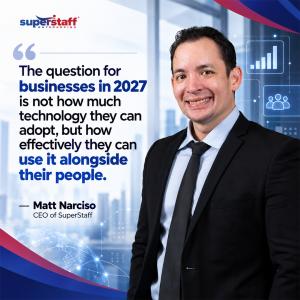
“The question for businesses in 2027 is not how much technology they can adopt, but how effectively they can use it alongside their people. AI and automation can improve efficiency, but businesses still need skilled professionals to manage complex tasks and maintain customer relationships. Outsourcing gives companies another way to bring these capabilities together while supporting growth.”
– Matt Narciso, CEO of SuperStaff
Business Planning for 2027 Will Require Clear Priorities
The convergence of AI, automation, and outsourcing presents real opportunities, but without clear objectives, new tools and partnerships can lead to higher costs and disappointing results. To avoid this, business leaders should anchor their growth strategies in three key areas: measuring operational performance to see how technology and outsourcing affect productivity and costs; preparing employees for evolving roles through practical training and soft-skill development; and carefully selecting external partners based on industry experience, data security, and service consistency.
These priorities encourage a holistic view, where technology and workforce decisions are part of a single operational strategy. Rather than investing in AI, automation, and outsourcing in silos, organizations can assess how each option addresses specific business needs, allowing for more careful resource management and better preparation for changes in customer demand.
Why it matters
As we move closer to 2027, the ability to execute a cohesive strategy that blends technology with human talent will separate market leaders from laggards. The data shows that simply buying more software or signing more contracts is not enough; the winners will be those who measure results and integrate these tools into their core operations. The takeaway for decision-makers is to focus on outcomes, not just adoption, and to view AI and outsourcing as complementary parts of a larger plan for sustainable growth.
Business growth in 2027 will ultimately depend on execution. Companies need clear goals, skilled employees, and dependable processes to manage costs and maintain service quality. Organizations like SuperStaff are positioned to help businesses access the skilled professionals and operational support needed to achieve these objectives.
Lorraine Opeña
SuperStaff