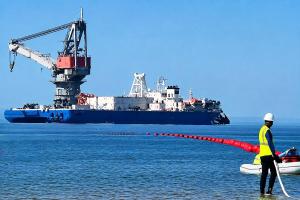
In a move that reshapes Eurasia’s digital backbone, NEQSOL Holding’s ambitious Digital Silk Way project has hit a key turning point. The official inauguration of the Trans-Caspian Fiber-Optic Cable—a critical piece of the broader corridor linking Europe and Asia—was celebrated this week, signaling a leap forward for regional connectivity.
The launch ceremony featured the participation of President of the Republic of Azerbaijan Ilham Aliyev and President of the Republic of Kazakhstan Kassym-Jomart Tokayev. In an online format, the two heads of state jointly inaugurated the first fiber-optic cable ever laid across the seabed of the Caspian Sea, a direct link between their two nations.
This undersea cable project is the result of a partnership between AzerTelecom—operating within Azerconnect Group, itself part of NEQSOL Holding—and Kazakhstan’s Kazakhtelecom. The two companies formed a joint venture, CaspiLink B.V., specifically to bring the project to life. Stretching 380 kilometers, the cable connects Sumgayit in Azerbaijan to Aktau in Kazakhstan, boasting a transmission capacity exceeding 400 terabits per second (Tbps).
Nasib Hasanov, Founder of NEQSOL Holding, underscored the strategic nature of the achievement: “The Caspian region has a unique position between Europe and Asia, and the Digital Silk Way aims to transform this advantage into a strong digital corridor. The installation of the first fiber-optic cable across the Caspian Sea is a major achievement toward this goal. We extend our sincere gratitude to the Presidents and governments of Azerbaijan and Kazakhstan for their significant support in making this project possible.”
Yusif Jabbarov, Chairman of the Board of NEQSOL Holding, added his own perspective on the broader impact: “The Trans-Caspian fiber-optic cable, a project of significant importance to the region, represents a strategic investment in Eurasia’s digital infrastructure. By establishing a high-speed, reliable and more efficient data transmission route between Europe and Asia, the project will strengthen international digital connectivity, contribute to regional cooperation and economic development.” He also credited the “professionalism, dedication and effective collaboration of the teams at AzerTelecom, Kazakhtelecom and CaspiLink B.V., as well as other parties involved in the project’s implementation” for reaching this milestone.
Bringing the cable to life was no simple feat. The endeavor required intricate technical and engineering operations, from identifying a safe and reliable cable route to conducting marine route surveys, manufacturing and delivering the cable, modifying a specialized vessel, and finally laying the fiber-optic line across the Caspian seabed.
The strategic importance of the Digital Silk Way project and the Trans-Caspian Cable has already been recognized in official declarations and documents adopted by international organizations and regional platforms, underscoring its geopolitical and economic relevance.
NEQSOL Holding, the parent entity driving this initiative, is an international group operating across 11 countries in sectors including telecommunications, energy, high-tech, construction, and mining. The group serves 25 million customers worldwide and employs more than 20,000 people.
AzerTelecom, the operator within the project, is the region’s largest international backbone provider, handling wholesale internet traffic, transit, transmission, and other telecommunications services. It operates under the Azerconnect Group umbrella within NEQSOL Holding.
Kazakhtelecom, for its part, is Kazakhstan’s largest telecommunications company and holds the status of national telecommunications operator, offering fixed-line telephony, broadband internet, digital television, mobile communications, and other services.
Why it matters: This undersea cable is more than a technical feat—it is a strategic asset that could reroute global data traffic, reducing reliance on existing chokepoints and accelerating digital trade between two continents. For businesses and governments along the corridor, it promises faster, more resilient connections that may spur economic integration and technological growth across the region.
Elmira Yenikeyeva
NEQSOL Holding
Visit us on social media:
LinkedIn