
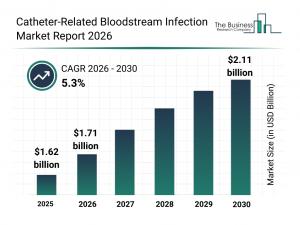
In an era where hospital-acquired infections are climbing and antimicrobial resistance is making headlines, one niche but critical healthcare market is drawing fresh attention. A new report from The Business Research Company projects that the catheter-related bloodstream infection (CRBSI) sector will swell to $2.11 billion by 2030, driven by rising infection rates, higher healthcare spending, and a push for better prevention tools.
The Business Research Company’s Catheter-Related Bloodstream Infection Global Market Report 2026 – Market Size, Trends, And Forecast 2026-2035
The catheter-related bloodstream infection market is experiencing consistent growth, spurred on by rising healthcare demands and ongoing improvements in infection-control technology. With hospitals and medical facilities placing greater emphasis on averting complications tied to catheter use, this sector is poised for long-term expansion. Below is a closer look at the current size of the market, the forces propelling it, the major players involved, and how different regions are shaping this essential area of healthcare.
Also worth a look: Anthropic pumps $50M into Bay Area nonprofits, starting with food banks and shelters and InterDigital warns AI and machine video will force cloud providers to rethink compression economics.
Current Market Size and Future Growth of the Catheter-Related Bloodstream Infection Market
The CRBSI market has seen notable growth in recent years. According to the report, it is expected to climb from $1.62 billion in 2025 to $1.71 billion in 2026, reflecting a compound annual growth rate (CAGR) of 6.0%. This upward trajectory stems largely from greater usage of central venous catheters, a rising number of hospital-acquired infections, broader adoption of antibiotic lock therapy, the expansion of intensive care units, and heightened clinical awareness of CRBSI risks. Looking further ahead, the market is forecast to reach $2.11 billion by 2030, with a CAGR of 5.3%. This future growth is being fueled by increased funding for infection prevention programs, growing efforts to manage antimicrobial resistance, the expansion of hospital infection control initiatives, wider use of combination therapies, and improvements in diagnostic tools. Key trends that will shape the market include the uptake of advanced antimicrobial lock solutions, more robust infection surveillance efforts, a strong emphasis on preventing hospital-acquired infections, the growth of combination antimicrobial therapies, and a focus on early diagnosis and timely treatment.
Download a free sample of the catheter-related bloodstream infection market report:
https://thebusinessresearchcompany.com/sample_request?id=68702434&type=smp&name=Catheter-Related%20Bloodstream%20Infection%20Market%20Report%202026&utm_source=EINPresswire&utm_medium=Paid&utm_campaign=Nov_PR
Understanding Catheter-Related Bloodstream Infection and Its Medical Significance
A catheter-related bloodstream infection happens when bacteria or fungi enter the bloodstream via a catheter—a tube inserted into a vein to deliver medications or nutrients. This type of infection is a serious healthcare-associated condition that can lead to sepsis and other severe complications if not caught and treated quickly. Effective management depends on rapid identification and intervention to lower risks and improve patient outcomes.
Hospital-Acquired Infections as a Key Market Driver for Catheter-Related Bloodstream Infection
The growing prevalence of hospital-acquired infections (HAIs) is a major factor pushing the CRBSI market forward. HAIs are infections patients pick up during medical treatment in healthcare facilities, typically appearing 48 hours or more after admission. Contributing factors include antimicrobial resistance, inadequate infection control practices, and vulnerable patient populations. Catheter-related bloodstream infections make up a significant share of HAIs because of their invasive nature and the risk of microbial colonization around indwelling catheters, which pose serious dangers to patients. For instance, in September 2025, data from the US National Library of Medicine revealed that in 2024, antimicrobial-resistant organisms accounted for 6.6% of infections. Roughly one-third of HAIs were linked to medical devices, and the prevalence of central line-associated bloodstream infections doubled to 0.4%. These numbers illustrate how the rising incidence of HAIs is driving demand in the CRBSI market.
View the full catheter-related bloodstream infection market report:
https://thebusinessresearchcompany.com/report/catheter-related-bloodstream-infection-global-market-report?utm_source=EINPresswire&utm_medium=Paid&utm_campaign=Nov_PR
Increased Healthcare Spending as a Catalyst for Market Expansion
Rising healthcare expenditure is another key factor supporting the growth of the CRBSI market. Healthcare spending refers to the total resources that individuals, organizations, and governments allocate toward preventing, diagnosing, and treating health conditions. Advances in medical technology—including new diagnostic tools and innovative therapies—often come with higher costs, which pushes overall healthcare spending upward. This investment helps reduce CRBSI rates by funding prevention strategies, staff training, monitoring systems, and timely treatment options, ultimately improving patient safety and cutting long-term costs. For example, in December 2024, the US Centers for Medicare & Medicaid Services reported that healthcare expenditures in the United States grew by 7.5% in 2023, reaching $4.9 trillion—about $14,570 per person. This rising investment in healthcare is a key driver fueling the expansion of the CRBSI market.
Regional Leadership and Market Distribution in Catheter-Related Bloodstream Infections
In 2025, North America held the largest share of the catheter-related bloodstream infection market, a reflection of its advanced healthcare infrastructure and high rates of catheter usage. The market analysis also covers several other important regions, including Asia-Pacific, Southeast Asia, Western Europe, Eastern Europe, South America, the Middle East, and Africa, offering a comprehensive look at global market dynamics and growth opportunities.
The 2026 edition of our market reports now delivers enhanced analytical coverage through market attractiveness scoring and analysis, total addressable market (TAM) analysis, company scoring matrix graphics and tables, Excel-based forecasting dashboards, market hotspots infographics, key technologies and future trend analysis, plus updated graphics and tables.
Speak With Our Expert:
Saumya Sahay
Americas +1 310-496-7795
Asia +44 7882 955267 & +91 8897263534
Europe +44 7882 955267
Email: marketing@tbrc.info
The Business Research Company – www.thebusinessresearchcompany.com
Follow Us On:
• LinkedIn: https://in.linkedin.com/company/the-business-research-company“
Oliver Guirdham
The Business Research Company
+44 7882 955267
info@tbrc.info
Visit us on social media:
LinkedIn
Facebook
X
Why it matters: As antimicrobial resistance and device-linked infections become more common, the CRBSI market’s growth reflects a broader shift toward proactive infection control in healthcare. With North America leading and global spending on prevention rising, the findings underscore the urgency of investing in diagnostics, antimicrobial therapies, and surveillance programs to curb a preventable but deadly threat.