
The numbers coming out of The Business Research Company’s latest forecast make one thing clear: the sky isn’t the limit for aerospace sensors—it’s just the starting line. With commercial aviation rebounding and defense fleets modernizing, the sector that keeps aircraft components precisely monitored is poised for sustained double-digit growth over the next decade.
The Business Research Company’s Aerospace and Aircraft Position Sensors Global Market Report 2026 – Market Size, Trends, And Forecast 2026-2035
Modern flight depends on an invisible network of highly precise instruments. Position sensors—the devices that track the location, angle, and movement of everything from landing gear to flight control surfaces—are the unsung backbone of aviation safety and efficiency. Here’s a closer look at where the market stands today and where it’s headed.
Also worth a look: Arbisoft deepens Salesforce partnership with 42 certifications and three free native apps and Eastern VA NABIP dumps email chaos for an AI hub that never sleeps.
Market Valuation and Growth Outlook
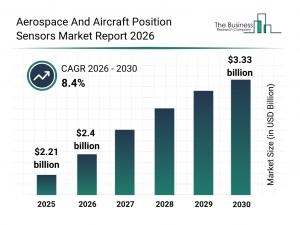
The aerospace and aircraft position sensors market has already shown impressive momentum. Valued at $2.21 billion in 2025, it is expected to climb to $2.4 billion in 2026—a compound annual growth rate (CAGR) of 8.9%. That surge is fueled by higher aircraft production and delivery volumes, a growing emphasis on safety systems, the industry-wide shift toward electronic flight controls, military fleet upgrades, and steady replacement demand from the aftermarket.
For those wanting a deeper dive, a free sample of the full report is available here:
https://www.thebusinessresearchcompany.com/sample_request?id=76069875&type=smp&name=Aerospace%20And%20Aircraft%20Position%20Sensors%20Market%20Report%202026&utm_source=EINPresswire&utm_medium=Paid&utm_campaign=Nov_PR
Looking further out, the market is projected to reach $3.33 billion by 2030, with a CAGR of 8.4%. That trajectory is supported by expanding commercial fleets, the rise of electric and hybrid aircraft, increased use of unmanned aerial vehicles, advanced actuation systems, and the integration of more reliable sensing technologies. Key trends to watch include non-contact sensing, miniaturization, high-temperature operation, multi-axis measurement, and fault-tolerant designs.
Understanding the Technology
These are not ordinary sensors. Aerospace-grade position sensors are engineered to convert mechanical movement into precise electrical signals under extreme conditions—high heat, vibration, pressure shifts, and electromagnetic interference. They must meet rigorous aerospace standards to ensure safe and dependable aircraft operation, making them a critical link in the chain of flight control.
Access the full report here:
https://www.thebusinessresearchcompany.com/report/aerospace-and-aircraft-position-sensors-market-report?utm_source=EINPresswire&utm_medium=Paid&utm_campaign=Nov_PR
Key Growth Drivers
The primary engine behind this expansion is the rising output of both commercial and military aircraft. Global air travel demand is pushing manufacturers to increase production, expand fleets, and meet defense needs—all while government investments accelerate modernization. Position sensors are essential here, providing the precise measurements needed for flight controls, landing gear, engines, and navigation systems that keep aircraft safe and reliable.
A concrete example: in July 2026, Airbus reported delivering 351 commercial aircraft in the first half of the year—a 14.7% increase over the 306 units shipped in the same period of 2025. That kind of production surge directly drives sensor demand.
Regional Market Patterns
In 2025, North America held the largest share of the market by value. But the Asia-Pacific region is expected to record the fastest growth over the forecast period. The report covers key areas including Asia-Pacific, South East Asia, Western Europe, Eastern Europe, North America, South America, the Middle East, and Africa, offering a comprehensive global view.
New analytical features added to the 2026 reports include:
- Market attractiveness scoring and analysis
- Total addressable market (TAM) analysis
- Company scoring matrix graphics and tables
- Excel-based forecasting dashboards
- Market hotspots infographics
- Key technologies and future trend analysis
- Updated graphics and tables
Speak With Our Expert:
Saumya Sahay
Americas +1 310-496-7795
Asia +44 7882 955267 & +91 8897263534
Europe +44 7882 955267
Email: marketing@tbrc.info
The Business Research Company – www.thebusinessresearchcompany.com
Follow Us On:
• LinkedIn: https://in.linkedin.com/company/the-business-research-company
Oliver Guirdham
The Business Research Company
+44 7882 955267
info@tbrc.info
Visit us on social media:
LinkedIn
Facebook
X
Why it matters: As aircraft production ramps up and new aviation technologies like electric and hybrid planes enter service, the demand for precision sensing will only intensify. Investors, manufacturers, and supply chain partners should watch this sector closely—it’s not just a niche component market, but a bellwether for the broader health and direction of the global aerospace industry.