
The automotive HVAC compressor market isn’t just growing—it’s being fundamentally reshaped by the electric vehicle revolution. According to a new report from The Business Research Company, this sector, valued at $8.74 billion in 2025, is on track to hit $12.75 billion by 2030, with electric vehicle production acting as the primary accelerant.

The Business Research Company’s Automotive Heating, Ventilation, and Air Conditioning (HVAC) Compressor Global Market Report 2026 – Market Forecast 2026-2035
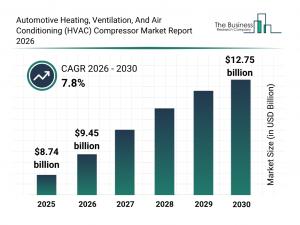
The automotive heating, ventilation, and air conditioning (HVAC) compressor market has been experiencing notable expansion, propelled by a combination of rising vehicle production and shifting consumer expectations. As cars become more technologically sophisticated and drivers demand greater cabin comfort, the need for efficient HVAC compressors continues to accelerate. This analysis examines the market’s size, key growth catalysts, regional trends, and the evolving competitive landscape.
Also worth a look: Anti-satellite weapons market rockets to $4.36B as global conflicts fuel demand and OpenAI’s IP chief says AI should mentor junior lawyers, not replace them.
Market Size and Growth Outlook
The global automotive HVAC compressor market climbed from $8.74 billion in 2025 to $9.45 billion in 2026, posting a compound annual growth rate (CAGR) of 8.2%, as detailed in the Automotive HVAC Compressor Market Report. This historical growth was fueled by higher vehicle production and sales, a growing emphasis on passenger comfort, widespread adoption of automotive air conditioning, increased vehicle usage in extreme climates, and rising replacement demand for worn compressors. Looking ahead, the market is projected to reach $12.75 billion by 2030, with a forecast CAGR of 7.8%. This future expansion reflects the growing need for energy-efficient compressors, the rising adoption of electric compressors in next-generation vehicles, demand for advanced thermal management solutions, and broader uptake of variable displacement compressor systems.
Download a free sample of the automotive heating, ventilation, and air conditioning (HVAC) compressor market report:
https://www.thebusinessresearchcompany.com/sample_request?id=83231111&type=smp&name=Automotive%20Heating%2C%20Ventilation%2C%20And%20Air%20Conditioning%20%28HVAC%29%20Compressor%20Market%20Report%202026&utm_source=EINPresswire&utm_medium=Paid&utm_campaign=Nov_PR
Key Drivers Supporting Market Expansion
A major catalyst behind this growth is the escalating production of electric vehicles—including battery electric vehicles, plug-in hybrids, and conventional hybrids. These vehicles demand specialized thermal management systems to operate efficiently, as they rely on electric powertrains rather than traditional internal combustion engines. Consequently, there is a surging need for electrically powered HVAC compressors that can deliver cabin cooling and temperature regulation independently of the engine.
Another powerful driver is the rising consumer emphasis on cleaner, more environmentally sustainable transportation that reduces fuel consumption and greenhouse gas emissions. This shift in preferences is accelerating EV adoption, which in turn expands the HVAC compressor market. According to the International Energy Agency (IEA), in May 2026, the number of electric car models worldwide increased by over 25% in 2025, compared to a 15% rise in 2024. This expansion in EV availability directly supports demand for advanced HVAC compressor technologies.
View the full automotive heating, ventilation, and air conditioning (HVAC) compressor market report:
https://www.thebusinessresearchcompany.com/report/automotive-heating-ventilation-and-air-conditioning-hvac-compressor-market-report?utm_source=EINPresswire&utm_medium=Paid&utm_campaign=Nov_PR
Understanding Automotive HVAC Compressors and Their Role
Automotive HVAC compressors are essential components that compress and circulate refrigerant through the air conditioning system, enabling effective cooling and maintaining comfortable cabin temperatures. Modern compressors are engineered with energy efficiency and enhanced thermal performance in mind. They are found not only in traditional internal combustion engine vehicles but also in hybrid and electric models, where they play a critical role in climate control systems.
Regional Dynamics
In 2025, Asia-Pacific held the title of the largest market for automotive HVAC compressors, a position it is expected to maintain throughout the forecast period. This region is also anticipated to post the fastest growth rate, driven by expanding vehicle production and rising consumer demand for comfort and advanced automotive technologies. The comprehensive market analysis covers regions including Asia-Pacific, South East Asia, Western Europe, Eastern Europe, North America, South America, the Middle East, and Africa, providing a global perspective on market trends and opportunities.
The 2026 market reports now feature expanded strategic intelligence through market attractiveness scoring and analysis, total addressable market (TAM) analysis, company scoring matrix graphics and tables, Excel-based dashboards, market hotspots infographics, key technology and future trend analysis, and updated graphics and tables.
Speak With Our Expert:
Saumya Sahay
Americas +1 310-496-7795
Asia +44 7882 955267 & +91 8897263534
Europe +44 7882 955267
Email: marketing@tbrc.info
The Business Research Company – www.thebusinessresearchcompany.com
Follow Us On:
• LinkedIn: https://in.linkedin.com/company/the-business-research-company
Oliver Guirdham
The Business Research Company
+44 7882 955267
info@tbrc.info
Visit us on social media:
LinkedIn
Facebook
X
Why it matters: As automakers race to electrify their fleets, the humble HVAC compressor is becoming a linchpin of vehicle efficiency and passenger comfort—not just an afterthought. Understanding this market’s trajectory offers a clear window into how the broader automotive supply chain is adapting to an electric future, with implications for manufacturers, suppliers, and consumers alike.