
When seconds separate life from death, the air ambulance becomes more than a helicopter with a stretcher — it becomes a critical artery of modern emergency medicine. New data from The Business Research Company reveals a sector that is not just growing, but evolving rapidly to meet surging global demand for rapid medical transport.
The Business Research Company’s Air Ambulance Services Global Market Report 2026 – Market Size, Trends, And Forecast 2026-2035
The air ambulance services market is experiencing notable expansion, driven by a worldwide increase in the need for swift medical evacuation and improvements in healthcare systems. As emergencies become more complex and patients require specialized care across greater distances, this industry is emerging as an indispensable component of urgent medical response networks. A closer look at the market reveals a compelling story of growth, regional shifts, and technological change.
Also worth a look: Bigwave Robotics brings Physical AI summit to Seoul with NVIDIA and eight other firms and Iqindia.net updates IQ Option guide for India, flags RBI rules and payout checks.
Market Size and Growth Trajectory
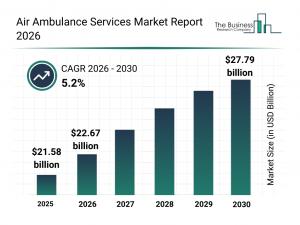
The air ambulance services market has shown robust momentum in recent years. According to the report, it is projected to climb from $21.58 billion in 2025 to $22.67 billion in 2026, representing a compound annual growth rate (CAGR) of 5.0%. This expansion is underpinned by several factors: gaps in local healthcare availability, rising emergency medical caseloads, expanding hospital networks, a growing number of road traffic accidents, and continued reliance on rotary-wing aircraft for critical patient transfers.
Download a free sample of the air ambulance services market report:
https://thebusinessresearchcompany.com/sample_request?id=48737756&type=smp&name=Air%20Ambulance%20Services%20Market%20Report%202026&utm_source=EINPresswire&utm_medium=Paid&utm_campaign=Oct_PR
Looking further ahead, the market is expected to maintain its upward momentum, reaching $27.79 billion by 2030 at a CAGR of 5.2%. Analysts point to several catalysts for this continued growth: significant investments in fixed-wing ambulance fleets, the expansion of cross-border patient transport services, advances in onboard medical technology, deeper partnerships between hospitals and independent operators, and growing government backing for emergency medical transport infrastructure. Emerging trends include heightened demand for time-critical emergency transfers, increased inter-facility medical relocations, specialized neonatal and infectious disease transport capabilities, improved organ transplant logistics, and a sharper focus on safety standards and operational uniformity.
What Air Ambulance Services Actually Do
At its core, air ambulance services involve moving patients via helicopter or airplane — but these are no ordinary flights. The aircraft are outfitted as mobile intensive care units, staffed by medical professionals who can deliver life-saving care mid-flight. For severely injured or critically ill patients, this rapid transport capability can mean the difference between recovery and tragedy, particularly when every minute counts.
View the full air ambulance services market report:
https://thebusinessresearchcompany.com/report/air-ambulance-services-global-market-report?utm_source=EINPresswire&utm_medium=Paid&utm_campaign=Oct_PR
The Chronic Disease Connection
Perhaps the most significant driver behind the market’s growth is the relentless rise of chronic diseases worldwide. Conditions such as cardiovascular disease, diabetes, and neurological disorders require ongoing medical management, and many patients need urgent transfers to specialized treatment centers. Sedentary lifestyles have only accelerated this trend, placing greater strain on healthcare systems that increasingly rely on air ambulances to bridge gaps in care.
The numbers are stark. In September 2025, the British Heart Foundation reported that over 7.6 million people in the UK are currently living with cardiovascular disease — more than 4 million men and 3.6 million women. Projections indicate that figure could rise by roughly 1 million by 2030 and approximately 2 million by 2040, driven by an aging population and improved survival rates from initial cardiac events. This growing patient pool is fueling demand for air ambulance services that can deliver timely, specialized treatment and improve outcomes.
Who Leads, and Who’s Catching Up
North America commanded the largest share of the air ambulance services market in 2025. But the fastest growth over the forecast period is expected to come from the Asia-Pacific region. The report provides comprehensive coverage across Asia-Pacific, South East Asia, Western Europe, Eastern Europe, North America, South America, the Middle East, and Africa — offering a detailed look at how different regions are positioning themselves in this expanding market.
The 2026 edition of the report includes enhanced market intelligence features: attractiveness scoring and analysis, total addressable market (TAM) analysis, company scoring matrices with graphics and tables, Excel-based forecasting dashboards, market hotspots infographics, key technology and future trend analysis, along with updated graphics and tables throughout.
Speak With Our Expert:
Saumya Sahay
Americas +1 310-496-7795
Asia +44 7882 955267 & +91 8897263534
Europe +44 7882 955267
Email: marketing@tbrc.info
The Business Research Company – www.thebusinessresearchcompany.com
Follow Us On:
• LinkedIn: https://in.linkedin.com/company/the-business-research-company.
Oliver Guirdham
The Business Research Company
+44 7882 955267
info@tbrc.info
Visit us on social media:
LinkedIn
Facebook
X
Why it matters: As chronic disease rates climb and healthcare systems stretch thin, air ambulance services are no longer a luxury — they are becoming a necessity for equitable access to emergency care. The market’s projected growth signals that governments, investors, and healthcare providers are betting heavily on faster, more specialized medical transport to save lives when ground-based options fall short.