
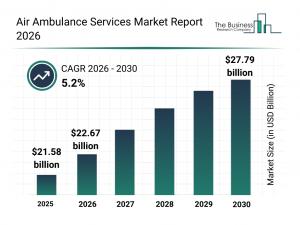
A grim reality is fueling a booming business: as chronic diseases surge worldwide, the air ambulance services market is preparing for its largest expansion yet. With projections showing a climb from $21.58 billion in 2025 to $27.79 billion by 2030, this sector is becoming an indispensable thread in the fabric of emergency healthcare.
The Business Research Company’s Air Ambulance Services Global Market Report 2026 – Market Size, Trends, And Forecast 2026-2035
The air ambulance services market is experiencing a powerful upswing, driven by a growing global appetite for rapid medical transport and steady improvements in healthcare infrastructure. As emergency medical needs escalate across continents, this industry is cementing its role as a critical lifeline for patients who are critically ill or badly injured. Here is a closer look at the market’s present state, the forces behind its growth, regional trends, and the emerging developments that will define its future.
Also worth a look: Iqsouthafrica.com breaks down IQ Option’s 2026 rules, payouts, and regulatory status for South African users and Vadzo Imaging validates Falcon-521CRS camera that processes images onboard, cutting host workload.
Current Market Size and Growth Outlook for Air Ambulance Services
The air ambulance services market has already recorded impressive growth in recent years. According to the latest data, it is on track to rise from $21.58 billion in 2025 to $22.67 billion in 2026, representing a compound annual growth rate (CAGR) of 5.0%. Several factors are driving this momentum, including gaps in service availability, rising emergency medical demands, the expansion of hospital networks, a higher number of road traffic accidents, and a growing reliance on rotary-wing aircraft for transporting critical patients.
Download a free sample of the air ambulance services market report:
https://thebusinessresearchcompany.com/sample_request?id=48737756&type=smp&name=Air%20Ambulance%20Services%20Market%20Report%202026&utm_source=EINPresswire&utm_medium=Paid&utm_campaign=Oct_PR
Looking further ahead, the market is expected to sustain its upward climb, hitting $27.79 billion by 2030 with a CAGR of 5.2%. This future growth will be underpinned by investments in fixed-wing ambulance fleets, the expansion of international patient transport services, technological upgrades to onboard medical equipment, stronger partnerships between hospitals and independent operators, and a rise in government initiatives supporting emergency medical transport. Key trends on the horizon include a heightened demand for rapid emergency transfers, broader inter-facility medical transport, increased use of specialized neonatal and infectious disease transport, improved organ transplant logistics, and a sharper focus on safety protocols and industry standardization.
Understanding Air Ambulance Services and Their Importance
Air ambulance services involve moving patients via helicopters or airplanes that are fully equipped to deliver medical care while in transit. These services offer critical support by swiftly transferring severely injured or ill individuals to facilities where they can receive the urgent treatment they need. This rapid transport capability can be the difference between life and death, especially in emergencies where every minute matters.
View the full air ambulance services market report:
https://thebusinessresearchcompany.com/report/air-ambulance-services-global-market-report?utm_source=EINPresswire&utm_medium=Paid&utm_campaign=Oct_PR
Chronic Disease Rise as a Major Growth Driver
A primary engine of growth for the air ambulance market is the escalating prevalence of chronic diseases across the globe. Conditions such as cardiovascular diseases, diabetes, and neurological disorders demand ongoing medical management, and many patients require fast transfers to specialized centers for effective care. The worldwide uptick in sedentary lifestyles has only added to the burden of these illnesses.
Consider this: in September 2025, the British Heart Foundation reported that more than 7.6 million people in the UK are currently living with cardiovascular disease—over 4 million men and 3.6 million women. Projections indicate that this number could rise by roughly 1 million by 2030 and by about 2 million by 2040, driven by an aging population and better survival rates. This trend is fueling a surge in demand for air ambulance services, as timely transport becomes essential for improving patient outcomes.
Regional Leadership in the Air Ambulance Market
In 2025, North America commanded the largest share of the air ambulance services market. However, the Asia-Pacific region is poised to become the fastest-growing market over the forecast period. The report covers a wide range of regions, including Asia-Pacific, South East Asia, Western Europe, Eastern Europe, North America, South America, the Middle East, and Africa, offering a thorough look at global market dynamics.
The 2026 reports are packed with enhanced market intelligence, including market attractiveness scoring and analysis, total addressable market (TAM) analysis, company scoring matrix graphics and tables, Excel-based forecasting dashboards, market hotspots infographics, key technologies and future trend analysis, and updated graphics and tables.
Speak With Our Expert:
Saumya Sahay
Americas +1 310-496-7795
Asia +44 7882 955267 & +91 8897263534
Europe +44 7882 955267
Email: marketing@tbrc.info
The Business Research Company – www.thebusinessresearchcompany.com
Follow Us On:
• LinkedIn: https://in.linkedin.com/company/the-business-research-company.
Oliver Guirdham
The Business Research Company
+44 7882 955267
info@tbrc.info
Visit us on social media:
LinkedIn
Facebook
X
Why it matters: The accelerating growth of the air ambulance market signals more than just a business opportunity—it reflects a fundamental shift in how healthcare systems respond to emergencies. As chronic disease rates climb and populations age, the ability to move patients quickly to specialized care will become a matter of life or death for millions. Investments in this sector today are laying the groundwork for a more responsive and resilient global healthcare infrastructure tomorrow.