For automakers and suppliers, the humble dashboard is becoming a high-tech command center—and a multibillion-dollar growth opportunity. A new forecast from The Business Research Company reveals that the global market for automotive instrument panel assemblies is poised for steady expansion, fueled by the rapid integration of advanced driver assistance systems (ADAS) and a shift toward more connected, lightweight vehicle interiors.

The Business Research Company’s Automotive Instrument Panel Assembly Global Market Report 2026 – Market Size, Trends, And Forecast 2026-2035
The automotive instrument panel assembly market has been experiencing notable growth, driven by the convergence of evolving vehicle technologies and rising consumer expectations around safety and cabin design. As cars become more technologically advanced, the need for integrated, sophisticated dashboard systems is becoming a critical factor in shaping the industry’s future. Here’s a look at the market’s current valuation, the primary growth engines, emerging trends, and how different regions are performing.
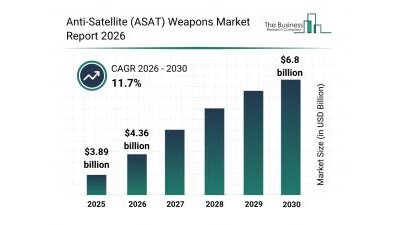
Also worth a look: Anti-satellite weapons market rockets to $4.36B as global conflicts fuel demand and OpenAI’s IP chief says AI should mentor junior lawyers, not replace them.
Market Size Outlook for the Automotive Instrument Panel Assembly Market
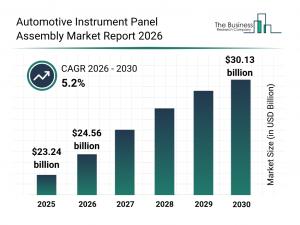
The automotive instrument panel assembly market has already seen significant expansion in recent years. According to the report, it is projected to climb from $23.24 billion in 2025 to $24.56 billion in 2026, reflecting a compound annual growth rate (CAGR) of 5.7%. This historical momentum is largely attributed to increased vehicle production, a growing preference for better interior aesthetics, the rising use of modular assemblies, deeper electronic component integration in dashboards, and a stronger focus on occupant safety. Looking further ahead, the market is expected to reach $30.13 billion by 2030, representing a CAGR of 5.2% during the forecast period. Factors supporting this long-term outlook include demand for lightweight instrument panel assemblies, the adoption of integrated cockpit architectures, more customization options for vehicle interiors, wider use of advanced composite materials, and the growing presence of premium and connected vehicle interiors. Key trends likely to shape the market include smart integrated instrument panels, lightweight dashboard structures, modular assembly designs, advanced interior finishes, and unified passenger and driver interface systems.
Download a free sample of the automotive instrument panel assembly market report:
https://www.thebusinessresearchcompany.com/sample_request?id=51797297&type=smp&name=Automotive%20Instrument%20Panel%20Assembly%20Market%20Report%202026&utm_source=EINPresswire&utm_medium=Paid&utm_campaign=Nov_PR
What Is an Automotive Instrument Panel Assembly?
An automotive instrument panel assembly is the combined structural dashboard module located at the front of a vehicle’s cabin. It serves as the mounting base for driver and passenger interface systems while improving ergonomics, safety, and interior styling. By merging structural, functional, and decorative components into a single unit, the assembly helps boost manufacturing efficiency, simplifies assembly processes, and supports the vehicle’s overall performance.
Key Drivers Behind Automotive Instrument Panel Assembly Market Growth
A major factor driving market expansion is the increasing adoption of advanced driver assistance systems (ADAS). These technologies rely on sensors, cameras, radar, and software to boost vehicle safety and convenience by offering features such as collision avoidance, adaptive cruise control, lane keeping assistance, and automated parking. The growing emphasis on vehicle safety from consumers, manufacturers, and regulators is accelerating the uptake of ADAS.
View the full automotive instrument panel assembly market report:
https://www.thebusinessresearchcompany.com/report/automotive-instrument-panel-assembly-market-report?utm_source=EINPresswire&utm_medium=Paid&utm_campaign=Nov_PR
How ADAS Influences Instrument Panel Assembly Demand
As ADAS technologies become more common, the need for sophisticated instrument panel assemblies that can integrate advanced sensors, displays, and electronic components is growing. These systems enhance driver information delivery, safety notifications, and the overall connected cockpit experience. For example, in October 2025, Thatcham Research—a UK-based automotive research organization—reported that 82% of drivers felt safer using ADAS technology, while 55% indicated that ADAS helped prevent accidents. Autonomous Emergency Braking (AEB) was highlighted as one of the most valuable features, underscoring the importance of ADAS in driving demand for advanced instrument panel assemblies.
Regional Highlights and Market Expansion
In 2025, Asia-Pacific was the largest regional market for automotive instrument panel assemblies and is also expected to be the fastest-growing region over the forecast period. The comprehensive market report covers regions including Asia-Pacific, South East Asia, Western Europe, Eastern Europe, North America, South America, the Middle East, and Africa, providing a global view of the market’s development trends.
What’s included in our 2026 market reports:
• Market attractiveness scoring and analysis
• Total addressable market (TAM) analysis
• Company scoring matrix graphics and tables
• Excel-based forecasting dashboards
• Market hotspots infographics
• Key technologies and future trend analysis
• Updated graphics and tables
Speak With Our Expert:
Saumya Sahay
Americas +1 310-496-7795
Asia +44 7882 955267 & +91 8897263534
Europe +44 7882 955267
Email: marketing@tbrc.info
The Business Research Company – www.thebusinessresearchcompany.com
Follow Us On:
• LinkedIn: https://in.linkedin.com/company/the-business-research-company
Oliver Guirdham
The Business Research Company
+44 7882 955267
info@tbrc.info
Visit us on social media:
LinkedIn
Facebook
X
Why it matters: As ADAS becomes a standard expectation rather than a luxury feature, the dashboard is no longer just a plastic housing for gauges—it is the nerve center of vehicle safety and connectivity. For suppliers and automakers, investing in modular, lightweight, and sensor-ready instrument panel assemblies will be essential to staying competitive in a market projected to grow by nearly $7 billion by 2030.