Digital tools are no longer optional in vehicle development — they are becoming the backbone of how cars are designed, tested, and brought to market. A new market analysis from The Business Research Company reveals that automotive simulation software is on track to surpass $9 billion by 2030, a clear signal that automakers are betting heavily on virtual testing to stay competitive.
The automotive simulation software market is rapidly evolving as the automotive industry embraces digital tools to enhance vehicle design and testing processes. With increasing demands for advanced technologies such as autonomous driving and electric vehicles, simulation software is becoming an essential component for innovation and efficiency in automotive development. Let’s explore the market’s current size, growth drivers, key segments, and leading players shaping its future.
Automotive Simulation Software Market Size and Its Share Within the Transport Industry
Projected to exceed $9 billion by 2030, the automotive simulation software market represents a small but significant part of the broader transport sector, which is expected to reach a staggering $9,400 billion in value by the same year. Specifically, this software segment is estimated to constitute roughly 0.1% of the total transport market, reflecting its growing yet specialized role in automotive engineering and development.
Also worth a look: Data lineage tools market to top $5B by 2030 as IBM leads a fragmented field and Outdoo AI launches AI trainers and closed loop coaching to fix AI skills gap.
Request A Free Sample Of The Automotive Simulation Software Market Report
https://thebusinessresearchcompany.com/sample_request?id=29381656&type=smp&name=Automotive%20Simulation%20Software%20Market%20Report%202026&utm_source=EINPresswire&utm_medium=Paid&utm_campaign=Oct_PR
North America Set to Dominate the Automotive Simulation Software Market in 2030
North America will hold the largest share of the automotive simulation software market by 2030, valued at $3.0 billion. From $1.7 billion in 2025, the market here is forecasted to grow at a 12% compound annual growth rate (CAGR). Key factors driving this growth include the rise of autonomous and connected vehicle technologies, widespread adoption of virtual testing and simulation-driven engineering, increased demand for electric vehicle optimization, expansion of automotive research and development centers, and strong collaboration between automakers, software developers, and technology firms across the United States and Canada.
United States Leading as the Largest Automotive Simulation Software Market Country in 2030
The USA will be the biggest national market within the automotive simulation software sector by 2030, with a valuation of $2.6 billion. Anticipated to grow from $1.5 billion in 2025 at a 12% CAGR, the US market’s expansion is fueled by high investments into advanced vehicle development projects, growing use of simulation for validation and virtual prototyping, increasing adoption of digital twin technology, and the rise of electric and autonomous vehicle testing programs. The integration of high-performance computing and analytics, combined with the country’s robust presence of automotive OEMs and technology companies, further boosts this growth.
Access The Detailed Automotive Simulation Software Market Report Here
https://thebusinessresearchcompany.com/report/automotive-simulation-software-market-report?utm_source=EINPresswire&utm_medium=Paid&utm_campaign=Oct_PR
Dominance of Software in Automotive Simulation Software Market Components
When segmented by component, software will be the largest portion of the market, accounting for 74% or $6 billion by 2030. This dominance stems from mounting demand for sophisticated simulation platforms that support vehicle design and performance analysis, virtual modeling tools for powertrain and vehicle dynamics, and integration with computer-aided engineering (CAE) solutions. The need for accurate safety and reliability testing, advancements in real-time scenario simulations, and the broader use of software-driven engineering workflows all contribute to the software market’s leading position.
Breakdown of Automotive Simulation Software by Type, Deployment, Application, and End User
The automotive simulation software market is categorized by software type into design simulation, performance simulation, crash simulation, multibody dynamics simulation, and thermal simulation software. Deployment modes include both on-premises and cloud-based software options. Applications cover vehicle dynamics, powertrain simulation, fuel efficiency simulation, noise, vibration, harshness simulation, and electronics simulation. End users range across original equipment manufacturers, automotive suppliers, academic institutions, and research organizations, reflecting the software’s versatile role throughout the automotive ecosystem.
Consistent 12% CAGR Expected Through to 2030
The overall automotive simulation software market is projected to grow at a steady compound annual growth rate of 12% leading up to 2030. This steady expansion highlights the increasing reliance on simulation tools as an integral part of modern vehicle development.
Main Drivers Accelerating Growth in the Automotive Simulation Software Market
One of the strongest growth catalysts is the rising adoption of Advanced Driver Assistance Systems (ADAS) and autonomous vehicles. Developing these technologies requires extensive virtual testing across countless driving scenarios, enabling safe, cost-effective validation of perception systems, sensor fusion, and decision-making algorithms. As complexity grows, reliance on high-fidelity simulation platforms intensifies, driving roughly 3.0% annual market growth.
Another significant driver is the ongoing electrification of vehicles. The surge in electric vehicle production increases demand for simulation tools focused on battery management, thermal regulation, power electronics, and powertrain optimization. Virtual modeling enables manufacturers to enhance vehicle range, efficiency, and safety prior to building physical prototypes, thereby shortening development cycles and reducing costs. This factor contributes approximately 1.0% annual growth to the market.
The rising pressure on automakers to cut vehicle development costs and accelerate time-to-market also fuels demand for simulation software. By enabling virtual prototyping, manufacturers reduce reliance on costly physical prototypes. Early design issue identification and performance optimization improve quality and shorten timelines. This trend accounts for around 0.8% annual market growth as engineering workflows increasingly incorporate digital tools.
Key Growth Opportunities Await in Software and Services Segments
Among the market segments, software and services are poised to generate the most significant growth opportunities, with combined market value surpassing $4 billion by 2030. This surge is driven by the adoption of cloud-based simulation platforms, collaborative development environments, cost-effective virtual validation, advanced computational modeling, and multi-domain simulations. The demand for simulation support services is also expanding, reflecting a growing focus on optimizing engineering efficiency and enabling next-generation vehicle innovations.
Notably, the software market alone is projected to increase by $3 billion from 2025 to 2030, while the services market is expected to grow by $1 billion in the same period. This growth highlights the expanding ecosystem of tools and expertise needed to support the complex demands of automotive development.
A Diverse Competitive Landscape Featuring Leading Technology Players
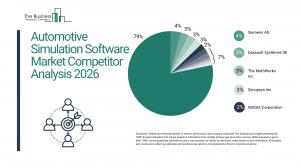
The automotive simulation software market is moderately fragmented, with the top 10 companies commanding 21% of total revenue in 2025. This moderate concentration stems from high technical barriers, specialized software requirements, and the necessity for integration with automotive engineering workflows. Leading players such as Siemens AG, Dassault Systèmes SE, The MathWorks Inc., Synopsys Inc., NVIDIA Corporation, PTC Inc., Hexagon AB, dSPACE GmbH, ETAS GmbH, and IPG Automotive GmbH maintain notable market shares through diverse software offerings, strong industry partnerships, and global distribution networks.
These companies focus on advancing simulation platforms, virtual testing solutions, digital twin technology, and AI-driven modeling to enhance vehicle development efficiency, safety, and performance. As demand for autonomous driving simulations, connected mobility, and digital twin platforms rises, these leaders are expected to strengthen their positions through innovation and strategic collaborations.
Siemens AG Leading the Market with Strong Digital Industries Software Division
According to recent research, Siemens AG led global automotive simulation software sales in 2025, holding a 4% market share. The company’s digital industries software division offers a wide array of simulation platforms, engineering solutions, digital twin technologies, and virtual validation tools supporting vehicle design, product development, and manufacturing processes, securing its place at the forefront of the market.
Prominent Companies Active in the Automotive Simulation Software Market
Key players operating in this space include Siemens AG, Dassault Systèmes SE, The MathWorks Inc., Synopsys Inc., NVIDIA Corporation, PTC Inc., Hexagon AB, dSPACE GmbH, ETAS GmbH, IPG Automotive GmbH, Keysight Technologies Inc., Moog Inc., FAAC Inc., Autodesk Inc., Applied Intuition Inc., Foretellix Ltd., Gamma Technologies LLC, VI-grade S.r.l., AVL List GmbH, Simerics Inc., and Cognata Ltd.
Important Raw Material Suppliers Supporting the Market
The automotive simulation software sector relies on major raw material suppliers such as NVIDIA Corporation, Intel Corporation, Advanced Micro Devices Inc., Qualcomm Incorporated, Texas Instruments Incorporated, NXP Semiconductors N.V., Infineon Technologies AG, STMicroelectronics N.V., Renesas Electronics Corporation, Analog Devices Inc., Microchip Technology Incorporated, Broadcom Inc., Marvell Technology Inc., Arm Limited, Siemens Digital Industries Software, Dassault Systèmes SE, Ansys Inc., Altair Engineering Inc., PTC Inc., Hexagon AB, Autodesk Inc., Bentley Systems Incorporated, Synopsys Inc., Cadence Design Systems Inc., and Keysight Technologies Inc.
Leading Distribution Channels in Automotive Simulation Software
Major wholesalers and distributors in this market include Arrow Electronics Inc., Avnet Inc., Digi-Key Electronics, Mouser Electronics Inc., Future Electronics Inc., TTI Inc., RS Group plc, Newark Electronics, Farnell, Macnica Inc., WPG Holdings Limited, Ingram Micro Inc., Tech Data Corporation, TD SYNNEX Corporation, ScanSource Inc., Bechtle AG, CDW Corporation, Insight Enterprises Inc., Redington Limited, Exclusive Networks SA, Westcon Group, ALSO Holding AG, Esprinet S.p.A., EET Group A/S, and Mindware FZ LLC.
Top End Users Driving Demand for Automotive Simulation Software
Notable end users of automotive simulation software include leading automotive manufacturers such as Toyota Motor Corporation, Ford Motor Company, General Motors Company, Volkswagen AG, BMW Group, Mercedes-Benz Group AG, Honda Motor Co. Ltd., Hyundai Motor Company, Nissan Motor Co. Ltd., Stellantis N.V., Tesla Inc., Tata Motors Limited, Volvo Car Corporation, BYD Company Limited, Rivian Automotive Inc., Lucid Group Inc., Mazda Motor Corporation, Subaru Corporation, Renault Group, Ferrari N.V., Porsche AG, Jaguar Land Rover Limited, Geely Automobile Holdings Limited, SAIC Motor Corporation Limited, and Mahindra & Mahindra Limited.
Transformative Trends Shaping the Market Landscape
Artificial intelligence (AI)-powered simulation platforms are revolutionizing the automotive simulation software market by enhancing virtual prototyping accuracy, speeding up design cycles, and boosting engineering productivity. For example, in February 2025, Altair Engineering launched Altair HyperWorks 2025, an AI-driven simulation suite tailored for automotive design and engineering. Its machine learning–based predictive modeling, automated design exploration, and cloud scalability improve simulation workflows and accelerate virtual prototyping for original equipment manufacturers and suppliers.
Strategic Moves Companies Are Making to Maintain Competitive Edge
To stay ahead, companies are focusing on advancing vehicle digital twin platforms that enable virtual prototyping and validation, leveraging AI simulation tools to improve design iterations and productivity, expanding hardware-in-the-loop simulation capabilities to strengthen automotive research and testing, and integrating AI with physics-based modeling to enhance simulation accuracy and development efficiency. These strategies collectively help firms respond to evolving industry needs and secure leadership in the competitive automotive simulation software market.
Expanded capabilities in our 2026 market reports:
• Market attractiveness scoring and analysis
• Total addressable market (TAM) analysis
• Company scoring matrix graphics and tables
• Excel-based forecasting dashboards
• Market hotspots infographics
• Key technologies and future trend analysis
• Updated graphics and tables
Learn More About The Business Research Company
The Business Research Company (www.thebusinessresearchcompany.com) is a leading market intelligence firm renowned for its expertise in company, market, and consumer research. We have published over 30,000+ reports across 27 industries and 60+ geographies. Our research is powered by 1,500,000 datasets, extensive secondary research, and exclusive insights from interviews with industry leaders.
We provide continuous and custom research services, offering a range of specialized packages tailored to your needs, including Market Entry Research Package, Competitor Tracking Package, Supplier & Distributor Package and much more.
Disclaimer: Please note that the findings, conclusions and recommendations that TBRC Business Research Pvt Ltd delivers are based on information gathered in good faith from both primary and secondary sources, whose accuracy we are not always in a position to guarantee. As such TBRC Business Research Pvt Ltd can accept no liability whatever for actions taken based on any information that may subsequently prove to be incorrect. Analysis and findings included in TBRC reports and presentations are our estimates, opinions and are not intended as statements of fact or investment guidance.
Contact Us:
The Business Research Company
Americas +1 310-496-7795
Europe +44 7882 955267
Asia & Others +44 7882 955267 & +91 8897263534
Email: marketing@tbrc.info
Follow Us On:
LinkedIn: https://in.linkedin.com/company/the-business-research-company
Oliver Guirdham
The Business Research Company
+44 7882 955267
Visit us on social media:
LinkedIn
Facebook
X
Why it matters: The explosive growth of this market points to a fundamental shift in how vehicles are engineered — from physical prototyping to virtual validation. As autonomy and electrification demand ever more complex testing, simulation software is becoming a critical competitive lever for automakers worldwide. Understanding these market dynamics helps industry stakeholders anticipate where investment and innovation are heading next.