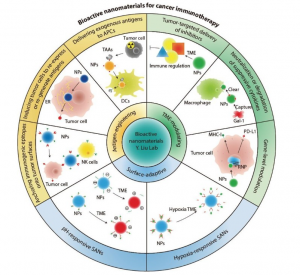
Cancer immunotherapy can lead to lasting responses, yet numerous tumors stay hard for immune cells to reach, identify, and eliminate. A recent review highlights how bioactive nanomaterials may overcome these obstacles via three interconnected approaches. Surface-adaptive nanomaterials shift their behavior when traveling from the bloodstream into tumors, antigen-engineering platforms render weakly immunogenic cancer cells more noticeable, and tumor microenvironment-modulating systems diminish signals that curb immune activity. By linking delivery, immune recognition, and local reprogramming, the model presents design guidelines for nanomedicines that could boost antitumor reactions, enhance treatment accuracy, and restrict unnecessary immune activation in healthy tissues across various tumor types.
Immune checkpoint inhibitors, cancer vaccines, and cellular therapies have transformed oncology, yet most patients still fail to achieve lasting benefits. Solid tumors build layered defenses: irregular blood vessels and dense tissue hinder drug access, unstable antigen expression diminishes immune recognition, and suppressive cells, cytokines, and metabolic conditions drain tumor-fighting lymphocytes. Systemic stimulation can also trigger immune-related side effects, creating a tough trade-off between effectiveness and safety. Nanomaterials provide adjustable size, surface chemistry, and cargo capacity, but systems designed around just one barrier may falter elsewhere along the treatment journey. Given these challenges, comprehensive research is required into integrated nanomaterials that coordinate tumor delivery, antigen presentation, and immune microenvironment reprogramming.
Researchers from Nankai University published (DOI: 10.1007/s10118-026-3567-z) the review online on April 24, 2026, in Chinese Journal of Polymer Science. The work outlines three complementary nanomaterial strategies aimed at overcoming physiological obstacles, boosting tumor immunogenicity, and easing immune suppression, offering a unified framework for creating more precise and effective bioactive nanomaterials for cancer immunotherapy and explaining how these methods might be merged.
The first approach focuses on surface-adaptive nanomaterials (SANs), which stay fairly steady during circulation but react to acidity or low oxygen levels inside tumors. These changes can expose sticky surfaces, improve tumor retention, or trigger controlled release of immune-regulating payloads. The second approach uses antigen engineering to restore immune visibility. Some nanoplatforms attach immunogenic signals to tumor-cell membranes, helping natural killer (NK) cells or tumor-associated macrophages spot malignant cells. Others induce endoplasmic reticulum stress or lysosomal disruption, prompting cancer cells to display immunogenic signals and release damage-associated molecular patterns (DAMPs). Additional systems capture tumor-associated antigens (TAAs) and deliver them to antigen-presenting cells (APCs), particularly dendritic cells (DCs), to support major histocompatibility complex class I (MHC-I) presentation and T-cell activation. The third approach reshapes the tumor microenvironment (TME) by concentrating checkpoint inhibitors inside tumors, removing suppressive proteins, or regulating immune-related pathways at the gene level. Studies covered in the review reported stronger tumor control, reduced metastasis, or improved immune activation in mouse models. Across these examples, the authors argue that circulation stability, tumor-selective activation, antigen presentation, and immune reprogramming should be designed as linked functions rather than isolated technical goals.
The authors stated that bioactive nanomaterials should be considered not merely as passive carriers, but as responsive systems that interact with shifting biological conditions. A clinically useful platform must remain controlled in the bloodstream, activate selectively within tumors, strengthen immune recognition, and reduce local suppression, they noted. The authors added that advancement will rely on clearer insights into nano-bio interactions, stronger immune-safety testing, predictable biodistribution, durable immune memory, and manufacturing methods capable of delivering reproducible materials at clinical scale, rather than just dramatic tumor shrinkage in small animal studies.
The framework could support nanomedicines customized to a patient’s tumor antigens, immune status, and microenvironment. Future platforms may combine programmable materials with engineered cells, ribonucleic acid (RNA) circuits, gene-editing tools, radiotherapy, chemotherapy, or targeted inhibitors to broaden therapeutic windows and overcome resistance. Translation will require standardized evaluation of cytokine release, complement activation, off-target immune stimulation, pharmacokinetics, clearance, and long-term protection against tumor recurrence. Good manufacturing practice (GMP)-compatible production and quality control (QC) will also be vital for batch consistency, stability, sterility, and scalability. Building these requirements into early design could help move promising preclinical systems toward clinical testing for immunotherapy-resistant cancers.
References
DOI
10.1007/s10118-026-3567-z
Original Source URL
https://doi.org/10.1007/s10118-026-3567-z
Funding Information
This study was financially supported by the National Natural Science Foundation of China (Nos. 52525310, 52373143, 22077073 and 52203172).
Lucy Wang
BioDesign Research
email us here