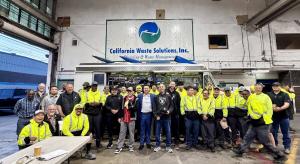
At the center of the frame stands Johnny Duong, Chief Operating Officer of California Waste Solutions, flanked by CWS team members at the company’s Oakland site.
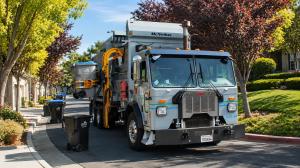
A California Waste Solutions recycling vehicle making its rounds for residents in San José, California.
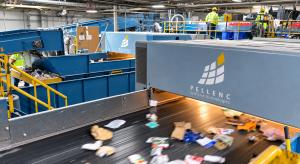
An interior view of a California Waste Solutions recycling plant located in San José, California.
CWS is set to roll out curbside pickup of household batteries in San José come 2027, paired with a fresh five-year deal with the Teamsters.
Our workforce is what makes these operations possible. Putting resources into them boosts our capacity to serve customers and grow initiatives like household battery collection.”— Michael Duong, President, California Waste SolutionsOAKLAND, CA, UNITED STATES, September 17, 2026 /EINPresswire.com/ — California Waste Solutions, Inc. is turning heads in San Jose this week, securing overwhelming employee backing for a new five-year contract while introducing a novel household battery collection service. The firm also served as a Diamond Sponsor for the Police Department Awards, underscoring its dedication to the community.
San Jose-based employees of California Waste Solutions, represented by the Teamsters, ratified a proposal from the company that includes higher wages, enhanced benefits, and improved vacation terms.
These upgraded employee perks arrive as California Waste Solutions gears up to gather household batteries from the curb for single-family residences in San Jose starting in early 2027, broadening a cart-top initiative the company has managed for the City of Oakland since 2015.
Michael Duong, President of California Waste Solutions, noted that these twin announcements highlight how crucial worker motivation is to advancing new service offerings.
“California Waste Solutions can deliver the services it does to customers because we’re a family-run business, and our staff are part of that family,” Duong remarked. “Their hard work is what lets us introduce the new battery collection and recycling service in the end.”
Duong added that these extra services are achievable thanks to the strong bond between the company and its employees.
Sergio Arrañaga, a business agent for Local 350 and lead negotiator for the union, stated: “This solid contract shows their dedication to elevating standards for workers across the waste sector,” Arrañaga said.
ABOUT THE UPCOMING BATTERY SERVICE
This service fits within San Jose's Recycle Right program, the same sorting guidelines residents already use at home. It targets a narrow yet costly gap in municipal recycling: an item that’s recyclable, hazardous if misplaced, and previously challenging to leave out.
"One constant in recycling since we started over three decades ago is the need to handle batteries correctly," said David Duong, Founder and Chief Executive Officer of California Waste Solutions. "We’ve been picking up household batteries at the curb for the last ten years in Oakland. We’re pleased San Jose residents will get that same chance."
Duong launched the company in Oakland in 1992 with just eight used collection trucks. Today, CWS serves over 343,000 customers in Oakland and San Jose, operating out of six Bay Area recycling facilities.
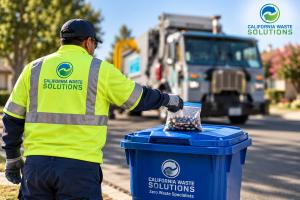
Residents are asked to place covered household batteries in a clear, resealable plastic bag around one quart in size, tape the terminals, seal it, and set it atop the recycling cart on collection day. Crews then remove the bag before the cart is dumped, ensuring it never touches the compacted load.
"This entire program is built so the battery stays out of the load," said Michael Duong, president of California Waste Solutions. "Sealed bag, taped terminals, placed on the cart, and moved to a separate truck compartment. Four steps, and the material remains isolated from start to finish."
IN DETAIL
The new service accepts alkaline and 9-volt batteries, along with coin and button lithium-ion cells found in watches, hearing aids, key fobs, and small gadgets. It excludes tool battery packs, lead-acid or vehicle batteries, and the larger rechargeable lithium-ion units used in power tools and consumer electronics.
However, these excluded items aren’t left without options. Santa Clara County offers a free household hazardous waste drop-off program by appointment, and San Jose lists retail take-back locations. CWS says it will back the city’s educational efforts on these distinctions.
Coin and button cells contain minimal energy, making them safe for sealed bags. Larger lithium-ion packs, though, can trigger thermal runaway, generating their own oxygen and resisting standard firefighting. San Jose already cautions residents that such cells can ignite fires if tossed in trash or recycling bins.
WHERE THE BATTERIES GO
Collected bags stay in a dedicated truck compartment for the entire route. They’re then consolidated at a CWS facility and shipped to a permitted battery recycler. The material never mixes with the commingled stream and avoids landfills. Steel, zinc, and manganese recovered from household alkaline cells are returned to manufacturing.
Recycling a battery costs significantly more than recycling nearby paper, glass, or plastic. Cells must be sorted by chemistry, packaged, and transported under hazardous-materials regulations, then processed at licensed plants. By weight, a household battery ranks among the priciest items in residential programs, yet CWS still collects them.
“Just as we’re ready to invest more in our employees, like in our latest Teamsters negotiation, we’re willing to pay extra for better service to our customers. For California Waste Solutions, employees and customers are one and the same: they’re the community members we see daily, shop alongside, and dine near. That’s why we invest in quality,” said President Michael Duong.
BATTERIES BREAK THE RECYCLING MODEL
CWS runs Pellenc optical sorters and is adding EverestLabs artificial-intelligence scanners to its lines. These systems can spot intact items moving at speed, but they can’t address a cell that’s already failed inside a collection truck.
"We’ve invested years in upgrading recognition tech on our lines, and it performs exactly as intended," Michael Duong explained. "It doesn’t solve this issue. By the time a battery hits the plant, the key decision was made at the cart. That’s not a tech problem—it’s an instruction problem, and it’s one we can solve with residents."
So, the control point is the cart, not the plant. The resident is the only one who can keep the cell out of the compactor. The city and the hauler are tasked with making the guidance clear enough to follow.
As highlighted in Recycling Today, California Waste Solutions recently announced adding AI technology to its optical sorting systems to assist employees in identifying items on the conveyor belt.
POWERING DOWN COSTS
Fire Rover, which tracks publicly reported fires at waste and recycling operations across the U.S. and Canada, logged 448 waste fires in 2025, with about 100 deemed catastrophic, causing roughly $2.5 billion in losses. Waste, paper, and plastic plants accounted for nearly half of these incidents, with batteries identified as a major trigger.
San Jose has already experienced a battery-related fire that destroyed a public recycling center, resulting in $6.8 million in damages.
CWS is also testing infrared cameras, smoke and heat detectors, and extinguishing systems on its collection vehicles.
"People don’t picture a person when they drop a battery in a cart, and that’s understandable, since you can’t see us from your driveway," David Duong noted. "But someone rides behind that load, and someone stands over it on the sorting line. They’re our employees and our family. A sealed bag on the cart protects them. So we invest in them."
California is building a producer-funded battery stewardship system under the Responsible Battery Recycling Act of 2022, with CalRecycle still drafting the rules. Until that system is operational, the practical route for a household battery in San Jose is the city's collection program and the company running it.
A SHARED SYSTEM
Recycle Right operates on the principle that residents sort properly, crews handle the bag, and batteries reach a permitted recycler—a logic CWS says it has followed since 1992. Oakland and San Jose maintain different accepted-material lists, so the company publishes city-specific guidelines rather than one-size-fits-all instructions that might be wrong for one city. It backs this with school visits, neighborhood events, multilingual resources, and work with property managers.
"We’re a community service company," David Duong said. "Our role is to make the right action easy, explain it clearly, and manage the material properly after residents do their part. That’s what we owe the cities we serve and their residents."
ALSO IN THE SAN JOSE DIARY THIS WEEK
California Waste Solutions again served as the Diamond Sponsor for the 2026 San Jose Police Department Major Awards Ceremony.
“This is one night when the city publicly acknowledges what its residents and officers accomplished this year,” said David Duong. “We were honored to sponsor the event again at such a high level, continuing our five-year partnership that began during Covid-19. It’s another key commitment we’ve made to community and to celebrating its top achievers.”
ABOUT CALIFORNIA WASTE SOLUTIONS
California Waste Solutions Inc. is a family-owned recycling and resource-recovery firm based in Oakland. Founded in 1992 by David Duong, it offers collection, processing, customer service, and material recovery for residential, commercial, and municipal clients across Northern California, including Oakland and San Jose. It runs six Bay Area recycling facilities and serves over 343,000 customers. City-specific recycling details are at calwaste.com/recycling-guide.
Wendy Nguyen
The King Of Trash
2066045675 ext.
email us here
Visit us on social media:
Instagram
Facebook
YouTube