
As factories and warehouses race to digitize operations, the private wireless networks underpinning those transformations are becoming a commercial force to watch. A new market forecast from The Business Research Company puts the industrial private 5G sector on a steep growth trajectory, with spending expected to more than triple by the end of the decade.
The Business Research Company’s Industrial Private 5G Global Market Report 2026 – Market Size, Trends, And Forecast 2026-2035
The industrial private 5G market is undergoing a rapid transformation as industries turn to advanced wireless technology to streamline operations. These dedicated networks provide secure, high-speed, and low-latency connectivity built specifically for industrial settings, making them increasingly vital to modern manufacturing and automation. Here’s a closer look at the market’s current size, growth drivers, and regional patterns shaping its future.
Industrial Private 5G Market Size and Growth Outlook
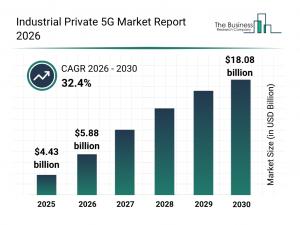
The industrial private 5G market has seen strong expansion in recent years, and that momentum shows no signs of slowing. The sector is projected to climb from $4.43 billion in 2025 to $5.88 billion in 2026, a compound annual growth rate (CAGR) of 32.8%. That historical surge is tied to mounting demand for dependable industrial wireless connections, the proliferation of connected devices on factory floors, the push for low-latency communications, broader deployment of automated machinery, and a growing emphasis on secure enterprise networks. By 2030, the market is expected to reach $18.08 billion, growing at a 32.4% CAGR. Forecast drivers include the need for high-capacity industrial networks, wider adoption of private 5G infrastructure, demand for deterministic wireless connectivity, expanded real-time data transfer in industrial processes, and the appeal of dedicated spectrum-based links. Emerging trends over the coming years point to greater use of dedicated private 5G spectrum, rising installations of industrial 5G networks, increased demand for low-latency connectivity in industrial environments, adoption of network slicing and edge computing, and sustained demand for reliable wireless communication across industrial applications.
Download a free sample of the industrial private 5g market report:
https://www.thebusinessresearchcompany.com/sample_request?id=42384157&type=smp&name=Industrial%20Private%205G%20Market%20Report%202026&utm_source=EINPresswire&utm_medium=Paid&utm_campaign=Oct_PR
Understanding Industrial Private 5G Technology
Industrial private 5G refers to exclusive 5G wireless networks deployed within industrial facilities to provide secure, high-speed, low-latency, and reliable connectivity. These networks operate on licensed, shared, or unlicensed spectrum bands and are purpose-built for sophisticated industrial use cases. They enable real-time communication, automation, equipment monitoring, and data exchange across connected devices, machinery, and systems, making them a cornerstone of digital transformation in industrial operations.
Industry 4.0 Initiatives as a Growth Catalyst for Industrial Private 5G
A key driver behind the industrial private 5G market’s expansion is the broad adoption of Industry 4.0 initiatives. These efforts focus on digitizing and modernizing production and operational processes through technologies like the industrial internet of things (IIoT), automation, artificial intelligence (AI), advanced data analytics, robotics, and connected systems. The push to enhance efficiency, operational visibility, and control is intensifying across manufacturing environments. As companies embrace automation, AI, IoT, and data analytics to boost productivity and enable smart manufacturing, the demand for robust wireless networks such as private 5G grows. These networks support advanced applications in smart factories, industrial IoT, robotics, and real-time monitoring by delivering high-speed, low-latency, secure, and reliable communications. For example, in March 2024, Rockwell Automation Inc., a US-based automation firm, reported that 83% of manufacturers expect to incorporate generative AI (GenAI) into their operations, while 95% are currently using or assessing smart manufacturing technologies, up from 84% in 2023. Those figures highlight how Industry 4.0 adoption is fueling demand for industrial private 5G solutions.
View the full industrial private 5g market report:
https://www.thebusinessresearchcompany.com/report/industrial-private-5g-market-report?utm_source=EINPresswire&utm_medium=Paid&utm_campaign=Oct_PR
Geographical Insights Highlighting Regional Growth in Industrial Private 5G
North America held the largest share of the industrial private 5G market in 2025, reflecting early adoption and established infrastructure. But Asia-Pacific is expected to grow the fastest over the forecast period, driven by rapid industrialization, expanding digital transformation efforts, and robust manufacturing sectors. The report covers regions including Asia-Pacific, South East Asia, Western Europe, Eastern Europe, North America, South America, the Middle East, and Africa, providing a comprehensive view of global market trends and opportunities.
Key enhancements in our 2026 market reports include:
• Market attractiveness scoring and analysis
• Total addressable market (TAM) analysis
• Company scoring matrix graphics and tables
• Excel-based forecasting dashboards
• Market hotspots infographics
• Key technologies and future trend analysis
• Updated graphics and tables
Speak With Our Expert:
Saumya Sahay
Americas +1 310-496-7795
Asia +44 7882 955267 & +91 8897263534
Europe +44 7882 955267
Email: marketing@tbrc.info
The Business Research Company – www.thebusinessresearchcompany.com
Follow Us On:
• LinkedIn: https://in.linkedin.com/company/the-business-research-company
Oliver Guirdham
The Business Research Company
+44 7882 955267
info@tbrc.info
Visit us on social media:
LinkedIn
Facebook
X
Why it matters: The projected surge in industrial private 5G spending signals a structural shift in how factories and industrial facilities will handle connectivity, data, and automation in the coming years. As manufacturers increasingly lean on AI and smart technologies, dedicated wireless networks are becoming the backbone of that digital evolution. For industry stakeholders, this forecast underscores the urgency of planning for private 5G investments to stay competitive.