The Business Research Company

The Business Research Company’s Observability Platform Market Report 2026 – Market Size, Trends, And Global Forecast 2026-2035
Businesses drowning in telemetry data are about to see that flood become a torrent — and the market for tools to make sense of it all is booming. New projections from The Business Research Company show the observability platform sector, which helps IT teams monitor and troubleshoot increasingly complex cloud environments, is on track for explosive growth over the next decade.
The observability platform market has seen notable expansion in recent years, driven by the growing need for visibility into intricate IT systems. As organizations increasingly depend on cloud technologies and distributed applications, the demand for solutions that monitor and analyze system performance has intensified. Here’s a look at the current market size, growth drivers, key players, and emerging trends shaping this dynamic industry.
Growth Trajectory and Market Size of the Observability Platform Market
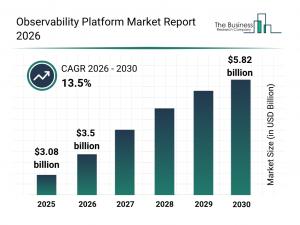
The observability platform market has experienced rapid development over the past few years. It is projected to grow from $3.08 billion in 2025 to $3.5 billion in 2026, reflecting a strong compound annual growth rate (CAGR) of 13.9%. This upward trajectory in the historical period is primarily attributed to the widespread adoption of cloud computing, the growing complexity of IT environments, the proliferation of distributed applications, an increased focus on application performance monitoring, and the rising need for proactive incident detection in IT operations.
Looking ahead, the market is expected to pick up even more momentum, reaching $5.82 billion by 2030 at a CAGR of 13.5%. Key factors driving this forecasted growth include rising demand for AI-powered observability tools, broader acceptance of hybrid and multicloud architectures, the need for real-time predictive monitoring, growing volumes of telemetry data, and the increasing importance of automated root cause analysis. Emerging trends expected to shape market dynamics include unified observability platforms, real-time telemetry data correlation, full-stack visibility, and deeper integration across hybrid and multicloud environments.
Download a free sample of the observability platform market report:
https://www.thebusinessresearchcompany.com/sample_request?id=64612563&type=smp&name=Observability%20Platform%20Market%20Report%202026&utm_source=EINPresswire&utm_medium=Paid&utm_campaign=Oct_PR
Understanding What an Observability Platform Does
An observability platform is a sophisticated software system designed to collect, correlate, and analyze diverse telemetry data — including metrics, logs, traces, and events — from applications, infrastructure, and networks. This comprehensive data aggregation provides organizations with clear insights into the health and performance of their IT systems. These platforms enable proactive issue detection and troubleshooting, help improve application reliability, streamline operational efficiency, and ensure smooth digital service delivery in modern, complex IT landscapes.
Cloud Computing as a Major Catalyst for Market Expansion
One of the primary factors propelling the observability platform industry is the growing adoption of cloud computing. Cloud computing offers on-demand access to shared resources such as servers, storage, software, and networking over the internet, allowing organizations to scale their digital operations flexibly without the need for extensive physical infrastructure.
The acceleration of digital transformation initiatives by enterprises is driving cloud adoption, which in turn increases the requirement for real-time monitoring and analytics that observability platforms provide. Distributed multi-cloud and hybrid environments especially depend on these platforms for maintaining application reliability, optimizing infrastructure, and enabling proactive resolution of IT incidents. For example, in March 2025, the Office for National Statistics reported that 69% of UK businesses had adopted cloud-based computing systems in 2023, highlighting the widespread embrace of cloud technologies. This surge in cloud computing usage is a key force behind the growth of the observability platform market.
View the full observability platform market report:
https://www.thebusinessresearchcompany.com/report/observability-platform-market-report?utm_source=EINPresswire&utm_medium=Paid&utm_campaign=Oct_PR
Regional Market Leadership and Growth Patterns
In 2025, North America held the largest share of the global observability platform market, establishing itself as the dominant regional player. However, the Asia-Pacific region is anticipated to witness the fastest growth during the forecast period. The market analysis encompasses major regions including Asia-Pacific, South East Asia, Western Europe, Eastern Europe, North America, South America, the Middle East, and Africa, providing a global perspective on market trends and expansion opportunities.
Our 2026 reports feature deeper market intelligence with market attractiveness scoring and analysis, total addressable market (TAM) analysis, company scoring matrix graphics and tables, Excel-based forecasting dashboards, market hotspots infographics, key technologies and future trend analysis, and updated graphics and tables.
Speak With Our Expert:
Saumya Sahay
Americas +1 310-496-7795
Asia +44 7882 955267 & +91 8897263534
Europe +44 7882 955267
Email: marketing@tbrc.info
The Business Research Company – www.thebusinessresearchcompany.com
Follow Us On:
• LinkedIn: https://in.linkedin.com/company/the-business-research-company
Oliver Guirdham
The Business Research Company
+ +44 7882 955267
info@tbrc.info
Visit us on social media:
LinkedIn
Facebook
X
Why it matters: As cloud adoption becomes near-universal — with 69% of UK businesses already on board — the observability market’s projected near-doubling in size signals that IT teams are prioritizing reliability and proactive incident response over reactive fixes. For enterprises, this forecast underscores the growing strategic importance of investing in tools that provide full-stack visibility, especially as AI-powered monitoring and multicloud complexity become the new norm.