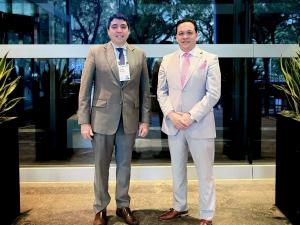
ANP Director Pietro Mendes (left) along with SFLCT Chairman Fernando C. Hernandez at CERAWeek 2026 in Houston, Texas
“Our commitment to advancing a low-carbon future is rooted in ‘Ordem e Progresso,’ always partnering with, and never placing ourselves above, those we work with.”— Fernando C. Hernandez, Chairman of the Board, SFLCT
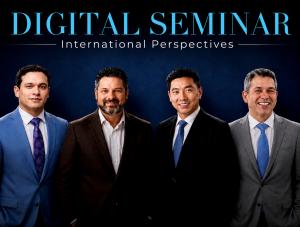
The Society for Low Carbon Technologies (SFLCT), partnering with Brazil’s National Agency of Petroleum, Natural Gas and Biofuels (ANP), jointly organized an international Digital Seminar aimed at supporting Brazil’s independent CCS pathway. Drawing over 60 attendees, the session expanded upon earlier SFLCT–ANP meetings held in the U.S. and Brazil, including talks between ANP Director Pietro Mendes and SFLCT Chairman Fernando C. Hernandez in Houston, Texas.
During the seminar, SFLCT and its Advisory Board shared real-world commercial expertise, leveraging the Chairman’s work on Bill 1425/2022 (dating back to 2022), which has since become Brazil’s CCS legislation. Drawing on sequestration know-how from ethanol, coal power, and oil sands operations—excluding Enhanced Oil Recovery (EOR)—SFLCT connected commercial deployment, governance, and operational standards to encourage knowledge transfer.
Notably, ANP is broadening its CCS regulatory role as Brazil advances South America’s first commercial CCS project through the ethanol-to-CCS route. Technical guidance for this initiative comes from the U.S. Environmental Protection Agency’s (EPA) Class VI Measurement Monitoring and Verification (MMV) criteria for a CO2 injection well (non-EOR).
This achievement directly corresponds with SFLCT’s hands-on background from the U.S. Blue Flint Project, which has permanently stored roughly 200,000 tonnes of CO₂ from ethanol production each year using an EPA Class VI well since 2023. That is why the seminar’s roundtable included SFLCT Advisory Board member Zach Liu—Director of Subsurface CCUS at Harvestone Low Carbon Partners and a significant figure in Blue Flint’s implementation—who provided operational lessons applicable to Brazil’s inaugural ethanol-to-CCS venture.
At the seminar’s start, SFLCT’s Chair delivered a “Global CCS Overview” talk and unveiled the 2026 Edition of SFLCT’s National Readiness Instrument for CCS (NRIC). This benchmarking tool, designed to scientifically assess and strengthen national preparedness for commercial CCS rollouts—from South America to South Asia—is adapted from NASA’s technology readiness level framework and applies space-grade logic to evaluate global CCS readiness through MMV-focused performance metrics.
Initially introduced in 2025 as the United Nations’ COP30 took place, the NRIC was presented to Brazil’s Ministry of Mines and Energy’s CCS Technical Executive Subcommittee during the formulation of the CCS Draft Decree. That Subcommittee assembled key participants, including SFLCT, ANP, and the developer of Brazil’s first CCS project. The Draft Decree is currently undergoing final executive review to fully activate Brazil’s CCS law.
The NRIC’s benchmarking approach is grounded in direct operational experience institutionally embodied by SFLCT. Specifically, the framework incorporates MMV data from the Blue Flint Project and Shell Canada’s Quest CCS Project—the Western Hemisphere’s first large-scale commercial CCS facility, which has permanently sequestered millions of tonnes of CO2 since 2015.
Drawing on his work at Quest, SFLCT Advisory Board member Dr. Matt Flannery created Quest’s foundational fluid characterization and monitoring program. Speaking as Director of Geoscience and Engineering at Stratum Reservoir, he presented “From the Western Hemisphere’s First CCS Project in Canada to U.S. Class VI Implementation: Technical Lessons Learned and Optimization Strategies,” illustrating how subsurface data and MMV approaches apply to Brazil’s CCS industry.
Furthermore, SFLCT Advisory Board member Stephen Pattee, P.G., Senior Vice President at Lonquist & Co., delivered “Insights from Supporting 120+ U.S. Class VI Projects and Canada’s First Coal-Fired Power CCS Project in a Deep Saline Formation.” His talk also referenced Lonquist & Co.’s participation in Canada’s Aquistore Project (included in the NRIC), reflecting his hands-on knowledge of how Class VI projects progress from concept to injection.
The organization’s collective global experience shows that SFLCT and the NRIC are founded on actual CCS deployment. Hernandez concluded, “Our commitment to advancing a low-carbon future is rooted in ‘Ordem e Progresso,’ always partnering with, and never placing ourselves above, those we work with.”
*Publishing note: The views expressed are those of the SFLCT, a federally recognized U.S.-based 501(c)(3) nonprofit, and do not necessarily reflect the positions of any organizations or individuals referenced herein. This publication is shared for educational, community-impact, and non-commercial purposes. No endorsement is implied. This publication aligns with SFLCT’s federally exempt status.*
Press Relations
Society for Low Carbon Technologies
email us here
Visit us on social media:
LinkedIn