With ransomware complaints climbing 18% in a single year, the software that keeps enterprise data safe from corruption and loss is no longer a back-office tool—it’s a boardroom priority. New market analysis from The Business Research Company tracks this surge in demand and projects where the industry is headed over the next decade.

The Business Research Company’s Data Protection And Replication Software Market Report 2026 – Market Size, Trends, And Global Forecast 2026-2035
The data protection and replication software market is expanding rapidly as organizations recognize that their most valuable asset—information—needs stronger safeguards. With enterprises generating unprecedented volumes of data and facing ever-more-sophisticated threats, the tools that ensure data stays intact and available have become essential infrastructure. Here’s a look at where the market stands, what’s driving its growth, and the innovations reshaping its future.
Steady Expansion of the Data Protection and Replication Software Market Size
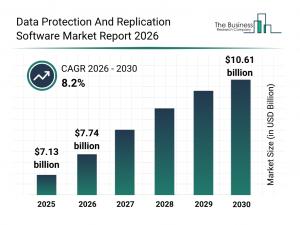
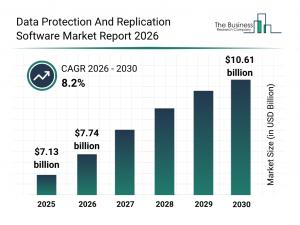
The sector has posted strong gains in recent years, and that momentum shows no signs of slowing. Valued at $7.13 billion in 2025, the market is projected to reach $7.74 billion in 2026—a compound annual growth rate (CAGR) of 8.6%. This upward trajectory is underpinned by several forces: the explosion of enterprise data creation, a rising tide of security breaches, accelerated digital transformation initiatives, a sharper focus on business continuity, and deeper reliance on enterprise applications and databases.
Download a free sample of the data protection and replication software market report:
https://www.thebusinessresearchcompany.com/sample_request?id=13639876&type=smp&name=Data%20Protection%20And%20Replication%20Software%20Market%20Report%202026&utm_source=EINPresswire&utm_medium=Paid&utm_campaign=Oct_PR
Outlook for Market Growth from 2026 to 2030
Looking further out, the data protection and replication software market is expected to climb to an estimated $10.61 billion by 2030, reflecting a CAGR of 8.2%. Several factors are expected to drive this next phase of growth: growing demand for cloud-based data protection services, wider adoption of hybrid IT architectures, the push for automated disaster recovery capabilities, tighter regulatory compliance mandates, and increased uptake of continuous data availability platforms. Among the emerging trends to watch are the mainstreaming of automated protection and replication tools, heightened emphasis on real-time data recovery, stronger enterprise data resilience frameworks, a preference for scalable management systems, and smoother data migration across varied storage environments.
Understanding Data Protection and Replication Software
At its core, this software category exists to shield critical data through regular backups, secure storage, and protection against loss, corruption, or system failures. The technology works by continuously creating and managing duplicate copies of data across multiple storage locations, enabling rapid recovery and keeping business operations running when disruptions hit.
View the full data protection and replication software market report:
https://www.thebusinessresearchcompany.com/report/data-protection-and-replication-software-market-report?utm_source=EINPresswire&utm_medium=Paid&utm_campaign=Oct_PR
The Impact of Growing Cyber Threats on Market Demand
Perhaps the single most powerful driver behind the market’s expansion is the escalating sophistication of cyber threats. These threats include malicious digital attacks aimed at compromising systems or stealing data. As internet usage and digital technologies spread, so do the vulnerable points attackers can exploit. Data protection and replication software counters this by maintaining secure backups and duplicates of critical data, giving companies the ability to restore operations quickly and limit damage from ransomware or other security breaches.
Rising Cybersecurity Incidents Highlight Market Necessity
Real-world data underscores the urgency. Figures from the Federal Bureau of Investigation’s Internet Crime Complaint Center (IC3) show ransomware complaints in the United States jumped from 2,385 in 2022 to 2,825 in 2023—an 18% increase. That trend line makes clear why effective data protection solutions are no longer optional, and why the market’s growth potential remains strong.
Regional Leaders Driving the Global Data Protection and Replication Software Market
Geographically, North America held the largest market share in 2025, buoyed by a mature digital infrastructure and heightened cybersecurity awareness. The Asia-Pacific region, however, is poised for the fastest growth over the forecast period, fueled by rapid digital adoption, expanding enterprise IT footprints, and rising investment in data security.
Broad Regional Coverage in Market Analysis
The report spans a wide geographic range—Asia-Pacific, South East Asia, Western Europe, Eastern Europe, North America, South America, the Middle East, and Africa—offering a comprehensive view of the global data protection and replication software landscape.
What’s new in our 2026 market reports:
• Market attractiveness scoring and analysis
• Total addressable market (TAM) analysis
• Company scoring matrix graphics and tables
• Excel dashboards
• Market hotspots infographics
• Key technologies and future trends
• Updated graphics and tables
Speak With Our Expert:
Saumya Sahay
Americas +1 310-496-7795
Asia +44 7882 955267 & +91 8897263534
Europe +44 7882 955267
Email: marketing@tbrc.info
The Business Research Company – www.thebusinessresearchcompany.com
Follow Us On:
• LinkedIn: https://in.linkedin.com/company/the-business-research-company
Oliver Guirdham
The Business Research Company
+ +44 7882 955267
info@tbrc.info
Visit us on social media:
LinkedIn
Facebook
X
Why it matters: As cyberattacks grow in frequency and severity, the software that protects and replicates data is becoming as critical as the data itself. Organizations that invest in these solutions now—particularly in fast-growing regions like Asia-Pacific—will be better positioned to weather disruptions and maintain business continuity in an increasingly volatile threat landscape.