Camera modules often push image-processing tasks onto the host computer, which can lead to inconsistent results across different systems. Vadzo Imaging’s latest validation of its Falcon-521CRS aims to change that by handling the work inside the camera itself.
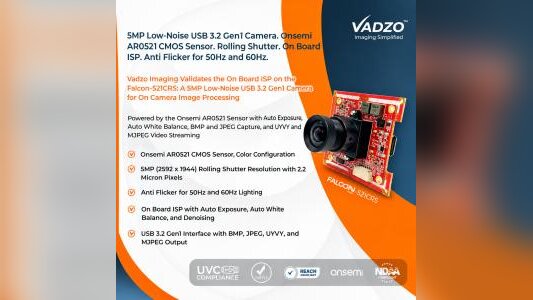
The Falcon-521CRS is a 5MP Low-Noise USB 3.2 Gen1 Camera with onboard ISP for on-camera processing, UVC controls, and consistent image output for OEMs at scale.
Vadzo Imaging, a provider of embedded vision camera products for OEMs and system integrators, today announces validation of the onboard ISP on the Falcon-521CRS 5MP Low-Noise USB 3.2 Gen1 Camera for on-camera image processing. Built on the Onsemi AR0521 sensor, the camera combines low-noise imaging, a high-performance ISP, anti-flicker control, automatic exposure, automatic white balance, and multiple video and still-image formats in a UVC-compliant module.
Also worth a look: Iqindia.net refreshes 2026 IQ Option guide for Indian traders with RBI, SEBI checks and IQ South Africa guide breaks down IQ Option’s rules, payouts and legal status for 2026.
With this validation, Vadzo presents a 5MP Low-Noise Color USB Camera for security and surveillance, retail automation, and medical device programs. The camera processes raw sensor data inside the module, helping deliver consistent images across different host platforms while reducing image-processing work for the host computer.
Why On-Camera Image Processing Matters in a 5MP Low-Noise USB 3.2 Gen1 Camera
Raw data from a camera sensor is not a finished color image. To get there, the data must go through demosaicing, color and contrast correction, gamma adjustment, noise reduction, and lens correction. Exposure and white balance also need to adapt to changing lighting conditions.
When the host computer handles these tasks, image quality can vary between systems depending on their processing capabilities, software versions, and tuning. This adds development effort, particularly for OEMs deploying camera units across different platforms.
A Host Offload Image Processing Camera moves these operations into the camera module. The onboard ISP processes the image before sending it to the host, helping maintain consistent output while allowing the host to focus on its primary application. This is especially useful for products deployed across multiple locations or operating systems.
Lighting introduces another challenge. Fluorescent and LED fixtures can produce flicker-related bands when exposure settings do not match the local power frequency. Support for both 50Hz and 60Hz anti-flicker settings helps integrators configure the camera for different regions. Automatic exposure and white balance further support consistent images as lighting conditions change.
Video and still-image formats also affect system design. Uncompressed video preserves image data but requires more bandwidth, while compressed video reduces data rates at the cost of potential compression artifacts. Selecting the appropriate formats early helps avoid integration changes later.
How the Falcon-521CRS Processes Images Onboard
The Falcon-521CRS is built on the Onsemi AR0521, a 5MP (2592 × 1944) color rolling shutter sensor with a 1/2.5-inch optical format and 2.2-micron pixels. Larger pixels collect more light during exposure, helping improve the signal in low-light conditions. The sensor’s back-illuminated structure further supports light collection.
These characteristics make the module an AR0521 Low Noise USB Camera and an AR0521 5MP Low Noise USB Camera, combining 5MP resolution with a pixel design suited to low-noise imaging.
The onboard ISP performs debayering, demosaicing, color correction, contrast correction, gamma correction, denoising, and lens correction. It also supports automatic exposure and automatic white balance. This makes the module an AR0521 On-board ISP USB Camera and a 5MP On-board ISP Camera, delivering processed images directly to the host.
The ISP also provides tuning controls through the standard UVC interface. Users can adjust brightness, exposure, contrast, sharpness, saturation, gamma, gain, white balance, and denoising through application software. This gives integrators control over image appearance without building a separate host-side processing pipeline.
Video Formats and USB Bandwidth
The Falcon-521CRS supports YUYV and MJPEG video formats. YUYV provides uncompressed image data, making it suitable for applications that depend on image detail. MJPEG compresses individual frames to reduce bandwidth and storage requirements, with some potential compression artifacts.
At 1080p resolution, uncompressed video requires substantial bandwidth, particularly at higher frame rates. USB 3.2 Gen1 provides a nominal data rate of 5Gbps, although practical throughput is lower. Integrators should evaluate resolution, frame rate, and format together to ensure the selected stream fits the available bandwidth.
The camera also supports BMP and JPEG still-image capture. BMP preserves image data without compression, while JPEG produces smaller files for storage and sharing. Applications can trigger still capture through software when a specific event or inspection step occurs.
Anti-Flicker for 50Hz and 60Hz Lighting
Mains-powered lighting commonly flickers at twice the supply frequency: 100Hz for a 50Hz supply and 120Hz for a 60Hz supply. When exposure settings do not account for this flicker, dark bands may appear in captured images.
The ISP provides anti-flicker settings for both frequencies. Selecting the appropriate setting helps reduce visible banding under fluorescent and LED lighting. Integrators should test the camera under their actual lighting conditions to confirm the required configuration.
Consistent Image Output Across Camera Units
An onboard ISP helps standardize image processing across camera units by using the same processing pipeline and default settings. Teams can tune the image once and apply consistent settings across deployments, reducing differences caused by host-side processing.
For applications involving multiple stores, clinics, or inspection stations, consistent color and exposure can make image review and analytics easier. However, projects requiring custom processing, such as specialized color matrices or access to raw sensor data, should discuss their requirements with Vadzo during the design stage.
The Falcon-521CRS uses a rolling shutter, which suits many stationary and moderate-motion scenes. Fast-moving subjects may show image skew, so applications involving rapid continuous motion should evaluate the effect using real-world footage. The module is UVC-compliant and supports Windows, Linux, and macOS without requiring a proprietary camera driver. It uses an S-Mount (M12) fixed-focus lens holder, so the working distance should be selected and verified during evaluation.
Product Overview
The Falcon-521CRS is a 5MP color USB module built on the Onsemi AR0521 sensor and validated for on-camera image processing. As an AR0521 Low Noise USB Camera, it starts with large pixels and low noise, and as an AR0521 5MP Low Noise USB Camera, it delivers the full 2592 x 1944 frame. The 5MP Onboard ISP USB Camera designation covers the finished image processing inside the module, and the 5MP USB 3.2 Gen 1 Camera designation covers its standard USB interface. The module combines the sensor, the ISP, and a USB 3.2 Gen1 controller with an S-Mount (M12) lens holder. It also serves as an AR0521 5MP Color USB Camera, an AR0521 Color Low Noise USB Camera, an AR0521 Color USB 3.2 Gen 1 Camera, and an AR0521 Rolling Shutter USB Camera for designs that need a standard interface.
Key specs: 5MP (2592 x 1944) Max Resolution | Onsemi AR0521 1/2.5-inch Sensor Format | 2.2-micron Pixel | Color with Rolling Shutter | USB 3.2 Gen1 Interface | S-Mount (M12) Fixed Focus Optics
Key Capabilities of the 5MP Low-Noise USB 3.2 Gen1 Camera
Rolling Shutter Performance
The sensor captures images row by row, supporting high-resolution imaging at a practical cost. This works well for stationary scenes and applications such as counters, shelves, and laboratory instruments. Fast-moving subjects can show skew, so integrators should evaluate the camera with their intended motion conditions. Vadzo also offers global shutter modules for applications where rapid motion capture is a priority.
Onboard ISP for Image Processing and Tuning
The onboard ISP converts raw sensor data into finished color images through demosaicing, color correction, contrast adjustment, gamma correction, denoising, and lens correction. A 5MP Onboard ISP Camera reduces the need for a separate host-side image-processing pipeline and helps maintain consistent output across camera units.
UVC controls allow teams to adjust image parameters through application software. Projects requiring raw data or specialized processing should discuss alternative module configurations with Vadzo.
Automatic Exposure and White Balance
Automatic exposure adjusts exposure and gain as lighting changes, while automatic white balance helps maintain natural colors under daylight, LED, and mixed lighting. The module functions as a 5MP AE AWB USB Camera, an AR0521 Auto Exposure Camera, and an AR0521 Auto White Balance Camera. Manual adjustment is also available for applications with controlled lighting.
BMP and JPEG Still-Image Capture
BMP captures uncompressed still images, making it suitable for applications requiring original pixel data. JPEG reduces file size for storage, review, and sharing. Software-triggered capture allows applications to record images during events such as product scans, inspections, or operator actions.
UYVY and MJPEG Video Streaming
YUYV provides uncompressed video for applications that prioritize image detail, while MJPEG reduces bandwidth and storage requirements through frame compression. Teams can compare both formats using their actual scenes and software to select the most suitable option.
Full HD and 5MP Resolution Modes
The Falcon-521CRS supports Full HD video for applications where 1080p resolution is sufficient, as well as its full 5MP resolution for tasks requiring additional detail. This makes it suitable as a Full HD USB Camera Module and a 1080p Full HD USB Camera Module. Vadzo supports OEM programs with lens matching, firmware customization, and enclosure design.
“Every camera processes its images somewhere. The question is who does the work and how consistently it is done. The Falcon-521CRS has a capable ISP inside the module, so color, exposure, noise reduction, and anti-flicker are handled through the same processing pipeline across units and hosts. UVC controls let customers tune the image from their own software, while BMP, JPEG, YUYV, and MJPEG provide options for different image and bandwidth requirements. We are also clear about the limits: rolling shutter suits many scenes, while teams requiring raw data and custom processing should discuss a raw sensor module with us.”
— Alwin Vincent, Product Manager, Vadzo Imaging
Applications of Consistent Image Processing
Security Monitoring with Consistent Color and Exposure
Security systems often use multiple cameras across different locations and host platforms. The Falcon-521CRS supports consistent image output through onboard ISP processing, automatic exposure, and automatic white balance. Anti-flicker settings help reduce banding under LED and fluorescent lighting, while low-noise imaging supports clear footage in suitable lighting conditions. Standardized image settings can also simplify footage review across multiple installations.
Retail Imaging for Shelf Monitoring and Product Recognition
Retail environments combine daylight, LED lighting, and illuminated displays. Automatic white balance helps maintain natural product colors, while automatic exposure adjusts image brightness as lighting changes. The camera’s processed output can support shelf monitoring and product recognition systems. Using a common camera module across stores can also simplify configuration, maintenance, and spare-parts management.
Low-Noise Imaging for Medical and Laboratory Devices
Medical and laboratory equipment can use the Falcon-521CRS for color imaging in digital microscopes and other instruments with suitable optics. Its low-noise sensor, onboard processing, and BMP still-image capture support applications requiring consistent image output and documentation. Device manufacturers remain responsible for validating illumination, image performance, and regulatory requirements for the completed device.
Frequently Asked Questions
Q: What is on-camera image processing, and why does it matter?
A: Raw sensor data must be processed through operations such as demosaicing, color correction, noise reduction, exposure control, and white balance to produce a finished image. When the camera’s ISP performs these tasks, the host receives processed frames, reducing integration effort and helping maintain consistent output across camera units. An Onboard Image Processing Camera can also reduce the processing work required from smaller host computers.
Q: Does an onboard ISP reduce the load on the host computer?
A: Yes. The ISP handles image-processing operations inside the camera, so the host does not need to build the entire pipeline from raw sensor data. The host may still need to decode compressed MJPEG video, while YUYV provides uncompressed frames. Integrators should measure processor usage with their actual host platform and selected video format.
Q: What does anti-flicker do at 50Hz and 60Hz?
A: Mains-powered lighting can flicker at 100Hz on a 50Hz supply and 120Hz on a 60Hz supply. Incorrect exposure settings can produce dark bands in the image. Anti-flicker settings help match exposure to the local lighting frequency and reduce visible banding. The appropriate setting should be selected and tested for the installation.
Q: Which still-image format should a team choose, BMP or JPEG?
A: BMP preserves image data without compression and is useful when retaining pixel information is important. JPEG produces smaller files for storage, sharing, and review, but introduces compression. The right format depends on the application’s image-quality and storage requirements.
Q: Why choose Vadzo Imaging as a 5MP USB 3.2 Gen1 Camera manufacturer?
A: Vadzo provides embedded camera modules with onboard image processing, UVC tuning controls, anti-flicker support, and multiple video and still-image formats. The company also supports OEM integration through lens selection, firmware customization, and enclosure design. Evaluation options allow teams to test the camera with their own host platforms before production.
Availability
The Falcon-521CRS 5MP Low-Noise USB 3.2 Gen1 Camera, built on the Onsemi AR0521 sensor, is available for evaluation and production orders. Evaluation kits include the camera module, S-Mount fixed-focus lens, USB 3.2 Gen1 cable, and platform documentation, with no minimum order requirement.
Teams can evaluate ISP controls, compare YUYV and MJPEG, and test anti-flicker performance under their actual lighting conditions before finalizing a production design. Integrators requiring a different lens or configuration can contact Vadzo to discuss their requirements.
Explore Vadzo’s USB camera portfolio or contact the team to discuss OEM integration requirements for security, retail, and medical device programs.
About Vadzo Imaging
Vadzo Imaging is a global provider of embedded vision solutions, offering camera technologies and imaging platforms for robotics, industrial automation, UAVs, edge AI, and medical systems. Its products are designed for integration with leading embedded platforms. Vadzo supports customers through hardware customization, firmware development, and module-level drivers across USB, MIPI, GigE, Wi-Fi, and SerDes camera interfaces.
Alwin Vincent
Vadzo Imaging
+1 817-678-2139
alwin@vadzoimaging.com
Visit us on social media:
LinkedIn
YouTube
X
—
**Why it matters:** For OEMs deploying cameras across multiple sites or systems, shifting image processing to the module removes a major source of variability and integration work. This validation signals a practical path toward more predictable vision-system performance without requiring proprietary drivers or custom host-side pipelines.