When a state legislature votes on the rules that will govern artificial intelligence, digital currencies, and personal data, the public rarely gets a clear, nonpartisan look at who is actually doing the work — until now. A new scorecard from South Carolina Blockchain Inc. promises to change that by grading every single member of the Palmetto State’s General Assembly on their documented technology policy record.
The inaugural review evaluates all 170 lawmakers across digital assets, privacy, artificial intelligence, and infrastructure, offering voters a detailed look at who is championing — or hindering — technology-friendly policies.
The report, published in SC Digital Ledger, Vol. I, No. 11, with results frozen on October 24, 2026, builds directly on the advocacy work of the South Carolina Emerging Technology Association (SCETA). South Carolina Blockchain Inc. has now taken that foundation a step further by launching Freedom Tech 2026, a comprehensive assessment of how each of the 170 members of the South Carolina General Assembly is shaping technology policy — and what those decisions mean for individual freedom, economic opportunity, and accountable government.
Also worth a look: Data lineage tools market to top $5B by 2030 as IBM leads a fragmented field and Automotive simulation software market heads to $9B as North America takes the lead.
At its core, Freedom Tech is the belief that technology should serve to strengthen individual liberty, expand economic prospects, and make institutions more transparent. The framework ties together the ability to own and use digital assets, safeguard personal information, choose payment methods, and access emerging technologies — while also acknowledging the need for clear, proportionate safeguards against legitimate harms.
As artificial intelligence, digital finance, and computing infrastructure continue to transform the economy, the policy decisions made in Columbia will help determine who gets to participate, who controls information, and how power is exercised. The stakes are tangible: household costs, business competitiveness, privacy protections, and the ability of communities to share in economic growth all hang in the balance.
The Freedom Tech review is designed to make those choices more transparent. By grading documented legislative conduct without regard to party affiliation, the report aims to help South Carolinians identify genuine leadership and hold their elected officials accountable for ensuring technology works for the people they serve.
The project emerged from Dennis Fassuliotis’s tenure as president of SCETA, where pushing for digital-asset rights raised a bigger question: how are lawmakers across South Carolina shaping the rules for technology in general?
“SCETA’s work brought us to the table. Freedom Tech asks us to look beyond our own bills,” Fassuliotis said. “I wanted to recognize substantive work wherever I found it and apply the same scrutiny to policies that could restrict individual rights or responsible innovation.”
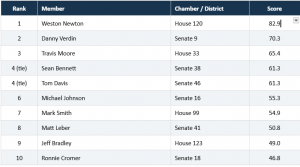
The approved results, frozen on October 24, place House Judiciary Chairman Weston Newton at the top with a score of 82.9. Sen. Danny Verdin follows in second with 70.3, and Rep. Travis Moore takes third with 65.4. Sens. Sean Bennett and Tom Davis are tied for fourth place at 61.3. The published table includes ten entries total.
“We don’t grade party; we grade policy and performance,” said Fassuliotis, who serves as president of South Carolina Blockchain Inc.
The scoring methodology is detailed and multi-faceted. Lawmakers can earn up to 30 points for policy advancement, 20 for origination and meaningful sponsorship, 15 each for institutional leadership and voting, and 10 each for constructive improvement and breadth of engagement.
A separate “Technology Friction” metric is recorded apart from the 100-point base score to capture supported restrictive effects alongside positive work. Moore’s published score, for example, reflects a 66.9 base minus a 1.5-point Technology Friction adjustment.
The review is careful to distinguish sponsorship from leadership, avoids double-counting achievements, and does not infer an individual vote from aggregate tallies. Firsthand evidence is kept separate from independently corroborated records, and a missing qualifying record is not treated as proof of opposition.
A “Good Goal / Wrong Approach” test evaluates whether a policy addresses a legitimate harm through a proportionate, least-restrictive effective remedy. The assessment focuses strictly on policy design and documented performance — not on the motives of the sponsors.
Importantly, the recognition reflects the documented legislative policy record and is not an endorsement of any candidate. The October 24 review is a dated snapshot; any later corrections or additions will be identified and dated accordingly.
South Carolinians can look up their own legislator by visiting https://freedomtechleaders.com to see how their representatives voted and performed in protecting rights and making technology work for the people.
The full report is available in SC Digital Ledger at https://digitalledgersc.substack.com.
South Carolina Blockchain Inc., founded in 2020, is a South Carolina public benefit corporation focused on education and public policy involving blockchain, digital assets, and emerging technologies. The organization publishes SC Digital Ledger to connect technology developments with economic opportunity, individual rights, and accountable government.
Dennis Fassuliotis
SCETA
+1 843-270-1016
Visit us on social media:
LinkedIn
X
Why it matters: This scorecard gives South Carolina voters a rare, nonpartisan tool to evaluate whether their elected officials are genuinely advancing technology policy that benefits the public — or simply paying lip service. With AI and digital finance reshaping the economy, having a transparent record of legislative performance could influence not just the next election, but the state’s competitiveness for years to come.