
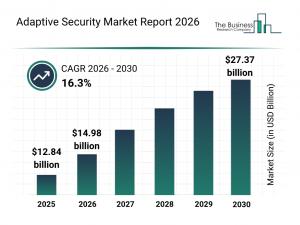
The numbers coming out of the adaptive security market are hard to ignore: a market already valued at $12.84 billion in 2025, now forecast to nearly double within five years. This growth isn’t happening in a vacuum — it’s a direct response to the kind of cyber threats that are making headlines and keeping security teams up at night.
The Business Research Company’s Adaptive Security Global Market Report 2026 – Market Size, Trends, And Forecast 2026-2035 lays out a clear picture of where the industry stands and where it’s heading.
The need for adaptive security — a proactive cybersecurity approach that continuously monitors users, devices, network traffic, and system behavior — has never been more urgent. As attack methods grow more complex and digital footprints expand, organizations are turning to solutions that can adjust defenses in real time rather than relying on static protections. This report breaks down current market size, the forces driving expansion, regional variations, and the trends that will define the sector’s trajectory.
Also worth a look: PSM Partners zeroes in on law firms, finance, and nonprofits to tackle rising compliance pressure and Wizardline names new C-suite as Domino’s data platform eyes global growth.
According to the report, the adaptive security market hit $12.84 billion in 2025 and is projected to climb to $14.98 billion in 2026, representing a compound annual growth rate (CAGR) of 16.7%. This rapid ascent is fueled by a surge in sophisticated cyberattacks, increased cybersecurity spending, broader cloud security adoption, the expansion of remote workforces, and tighter regulatory compliance requirements.
Access a free sample of the adaptive security market report here:
https://www.thebusinessresearchcompany.com/sample_request?id=68944008&type=smp&name=Adaptive%20Security%20Market%20Report%202026&utm_source=EINPresswire&utm_medium=Paid&utm_campaign=Nov_PR
Looking further ahead, the market is expected to maintain its momentum, reaching $27.37 billion by 2030 with a CAGR of 16.3%. Analysts attribute this long-term growth to rising demand for autonomous threat response, expanded use of adaptive identity and access management, the need for continuous risk assessments, broader application of behavioral threat detection, and increasing popularity of managed adaptive security services. Key trends during this period include continuous threat monitoring, real-time threat detection, automated security responses, risk-based security controls, and dynamic evaluations of user and device risks.
So what exactly is adaptive security? It’s a cybersecurity strategy that relies on automation, artificial intelligence, and real-time risk scoring to prevent, detect, and mitigate attacks more effectively. By constantly adjusting protections based on emerging threats, adaptive security helps organizations close vulnerabilities, strengthen defenses, and keep operations running smoothly.
View the full adaptive security market report:
https://www.thebusinessresearchcompany.com/report/adaptive-security-market-report?utm_source=EINPresswire&utm_medium=Paid&utm_campaign=Nov_PR
Perhaps the most striking driver behind this market’s growth is the rising sophistication of cyberattacks themselves. These are no longer simple breaches — they are malicious operations where attackers use artificial intelligence to automate intrusions, evade detection, and craft more convincing phishing or malware campaigns. This escalating threat complexity directly fuels demand for adaptive security solutions that offer intelligent, real-time detection and automated response. A telling example: in October 2025, the UK’s National Cyber Security Centre reported that nationally significant cyberattacks had more than doubled, reaching 204 incidents in the year ending September, compared to just 89 the year prior. That surge underscores how advanced threats are accelerating market growth.
Geographically, North America held the largest share of the adaptive security market in 2025, reflecting its advanced cybersecurity infrastructure and investment levels. However, the Asia-Pacific region is projected to be the fastest-growing market over the forecast period, driven by rapid digital transformation and rising cybersecurity awareness. The report covers multiple regions including Asia-Pacific, South East Asia, Western Europe, Eastern Europe, North America, South America, the Middle East, and Africa.
What’s included in our 2026 market reports:
• Market attractiveness scoring and analysis
• Total addressable market (TAM) analysis
• Company scoring matrix graphics and tables
• Excel-based forecasting dashboards
• Market hotspots infographics
• Key technologies and future trend analysis
• Updated graphics and tables
Speak With Our Expert:
Saumya Sahay
Americas +1 310-496-7795
Asia +44 7882 955267 & +91 8897263534
Europe +44 7882 955267
Email: marketing@tbrc.info
The Business Research Company – www.thebusinessresearchcompany.com
Follow Us On:
• LinkedIn: https://in.linkedin.com/company/the-business-research-company
Oliver Guirdham
The Business Research Company
+44 7882 955267
info@tbrc.info
Visit us on social media:
LinkedIn
Facebook
X
Why it matters: The doubling of the adaptive security market within five years signals that static, perimeter-based defenses are no longer sufficient for modern enterprises. As attackers increasingly weaponize AI, organizations that fail to adopt dynamic, real-time security strategies risk falling behind — and the data suggests the gap between prepared and unprepared companies will only widen.