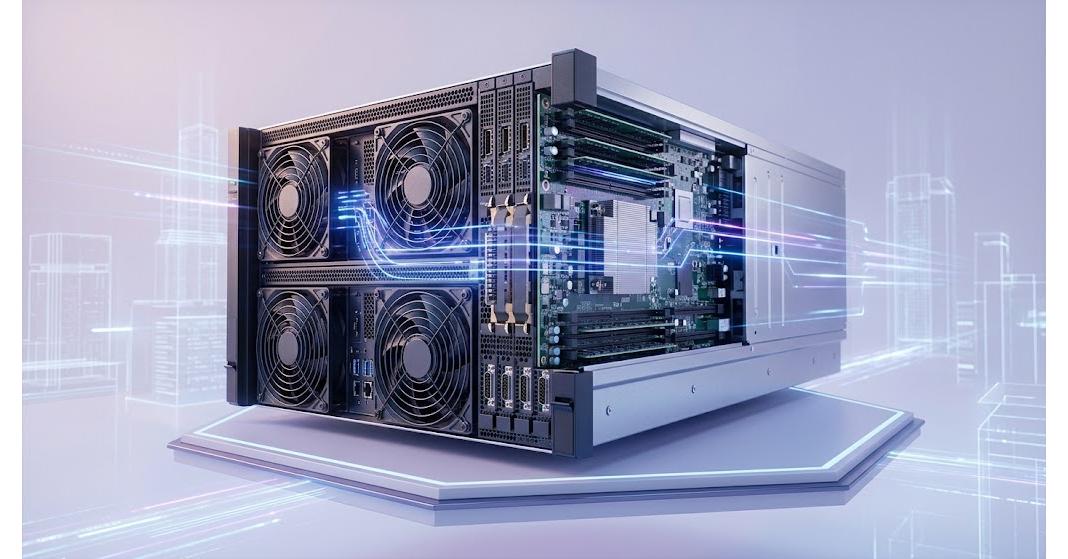
Advids video production solution for Industrial Electronics
IT Infrastructure, Embedded & Networking Systems Video by Advids
Advids introduces a specialized video offering for IT and Industrial Electronics, helping brands connect with technical buyers who favor video over gated PDFs.
Trust now hinges on visibly proving real engineering depth. Long-form video demos and case studies let brands actually demonstrate, rather than merely claim, that technical expertise.”— Avilash Behera, Founder of AdvidsPALO ALTO, CA, UNITED STATES, August 25, 2026 /EINPresswire.com/ — According to the ninth annual State of Marketing to Engineers study by TREW Marketing and GlobalSpec, 70% of engineers regularly watch job-related video on YouTube, and when assessing vendors they prefer long-form product demos, reviews, and case studies. The same research shows that 68% of B2B buyers believe most brands sound alike. Today, Advids—a B2B video production agency collaborating with engineering and IT teams across enterprise hardware, industrial systems, and cybersecurity infrastructure—announced a dedicated video production solution for IT Infrastructure and Industrial Electronics companies.
The solution formalizes work already underway in this category. Advids has created video for HPE in enterprise computing and hybrid cloud infrastructure, Barracuda Networks in network security, Cohesity in data management and cyber resilience, and Hytera in industrial and public-safety communications hardware—categories spanning compute, storage, security, and industrial communications. The company holds a 5.0 rating on Clutch and 4.7 on G2 across its broader video portfolio.
Reaching a technical buyer has become structurally more difficult. A modern enterprise security program alone encompasses ten distinct control categories—identity, endpoint, network, cloud, application, data, and more—with no single vendor covering all ten, leaving a typical enterprise managing 8 to 15 security vendors simultaneously. A buyer juggling that many relationships, receiving pitches from all of them, in a market where two-thirds of buyers say the messaging is interchangeable, does not lack information. They lack any reason to give one vendor a closer look over another. Advids calls this the Explanation Gap, and in this category it is less about complexity than about attention.
How that buyer decides has shifted alongside this. Engineers now conduct extensive independent research and form strong opinions well before contacting a vendor, with technical publications and vendor websites as their leading sources of product information. Trust is unevenly distributed: 66% of technical buyers rate engineering experts at vendor companies as their most trusted content authors, while generative AI tools rank lowest among all sources measured. The practical implication for a marketing team is that credibility now depends on visibly demonstrating real engineering depth—something a claim in a datasheet asserts but cannot show.
The formats most companies rely on work against this. Thirty-seven percent of technology buyers say they are less likely to consider a vendor that gates its first piece of content, and 75% say the same of a vendor that gates everything—which puts the standard registration-walled whitepaper directly at odds with how these buyers prefer to research. Brand recognition compounds the effect: 53% of technical buyers say brand familiarity influenced their most recent purchase, and 70% say they are more likely to choose a well-known brand when comparing similar solutions. Being known before the evaluation starts is now a commercial advantage, not a vanity metric.
That advantage is contested in crowded rooms. Embedded World 2026 drew roughly 36,000 attendees to Nuremberg—alongside 1,242 exhibitors competing for their attention. In an environment where every booth claims performance, reliability, and integration, the differentiator is whichever company can make an engineer stop and actually understand what they are looking at.
Two use cases anchor the solution. The Attention Booth positions a platform for the moments where recognition is won or lost—a product reveal, a funding announcement, a major trade show floor. Trust Enablement engages the technical community directly, offering clear visual validation of proprietary technology to the engineers and evaluators who will scrutinize it, in the long-form demo and case-study formats they already prefer.
The production process—Ingest, Spatial Blueprint, Cinematic Rendering, Deploy—pairs STEP models, schematics, and technical whitepapers, absorbed under NDA, with a narrative built around a product's specific technical advantage, then rendered as photorealistic 3D motion graphics for investor decks, the web, and the exhibition floor. Because hardware iterates—a new server generation, an updated rack design, a next-generation module—the solution also includes what Advids calls Modular Architecture: updating a project's visual layers to match the next revision, rather than starting over.
"The buyers in this category do most of their deciding before anyone in sales hears their name. They trust engineers, they distrust marketing language, and they will not fill in a form to find out whether your product is worth their time. That is a hard set of conditions for a datasheet and a gated PDF. It is a good set of conditions for video that respects what they already know," said Avilash Behera, Founder of Advids.
The gap between how these buyers want to learn and what most vendors produce is unlikely to close on its own. Ninety-one percent of B2B technology buyers say they prefer video over written content when learning about a complex product, according to Brightcove, and manufacturers who add video to their technical profiles see measurably higher engagement on RFP-stage inquiries. Advids says the companies that grow fastest in IT infrastructure and industrial electronics over the next several years will be the ones an engineer already understands and recognizes before the formal evaluation begins.
Avilash Behera
Advids
avilash@advids.co
Visit us on social media:
LinkedIn
YouTube
Advids | The world's most complex tech, explained simply.