
As preterm birth rates tick upward and hospitals push for smarter remote care, the market for AI-powered neonatal monitoring is quietly becoming one of the fastest-growing corners of health tech. New projections from The Business Research Company show a sector poised to nearly double in value within five years, driven by advances in sensors, predictive analytics, and cloud-based care platforms.
The Business Research Company’s Artificial Intelligence (AI)-Enhanced Remote Neonatal Monitoring Global Market Report 2026 – Market Size, And Forecast 2026-2035

Artificial intelligence is reshaping how the most vulnerable newborns are monitored, moving critical care beyond hospital walls. By continuously analyzing vital signs and physiological data, these systems offer real-time health insights and early warning signals for complications — a capability that is drawing serious attention from healthcare providers, especially for premature and high-risk infants. Here is a closer look at where this market stands today, what is fueling its expansion, and where it is headed next.
Also worth a look: AIM Intelligence scores second place, three wins at Singapore’s SLINGSHOT 2026 and TESCO Metering taps AI veteran David Schamber to lead software and grid innovation.
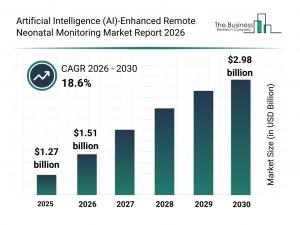
Market Size and Growth Outlook for AI-Enhanced Remote Neonatal Monitoring
The sector has grown rapidly in recent years. According to the report, the market is projected to climb from $1.27 billion in 2025 to $1.51 billion in 2026 — a compound annual growth rate (CAGR) of 18.9%. That momentum is attributed to a rise in premature births, the expansion of neonatal intensive care units, broader adoption of remote patient monitoring tools, a heightened focus on early intervention for newborns, and continuous improvements in sensor technology. By 2030, the market is expected to reach $2.98 billion, sustaining a CAGR of 18.6%. Growth drivers include the increasing deployment of AI-driven monitoring systems, rising demand for home-based neonatal care, progress in predictive health analytics, the integration of cloud platforms, and a broader shift toward preventive neonatology. Emerging trends include continuous vital sign tracking, AI-based early warning systems, wearable neonatal sensors, and remote care models backed by predictive analytics.
Download a free sample of the artificial intelligence (ai)-enhanced remote neonatal monitoring market report:
https://thebusinessresearchcompany.com/sample_request?id=35073574&type=smp&name=Artificial%20Intelligence%20%28AI%29-Enhanced%20Remote%20Neonatal%20Monitoring%20Market%20Report%202026&utm_source=EINPresswire&utm_medium=Paid&utm_campaign=Oct_PR
Understanding AI-Enhanced Remote Neonatal Monitoring
At its core, AI-enhanced remote neonatal monitoring uses sophisticated algorithms to continuously track and interpret the vital signs and physiological data of newborns — particularly those born prematurely or classified as high-risk. The technology enables predictive assessments and early detection of health issues, supporting timely, informed clinical decisions even when care is delivered outside traditional hospital settings.
The Rising Incidence of Preterm Births as a Market Growth Driver
A key accelerant for the AI-enhanced remote neonatal monitoring market is the increasing rate of preterm births. Babies born before 37 weeks of gestation often face serious health challenges due to underdeveloped organs, requiring specialized and vigilant care. The uptick in preterm deliveries is partly tied to older maternal age, which raises the risk of pregnancy complications. AI-based remote monitoring helps manage these cases by offering continuous data analysis that can flag early signs of complications, enabling prompt intervention and safer post-discharge care. For context, the Centers for Disease Control and Prevention (CDC) reported that the U.S. preterm birth rate rose slightly from 10.38% in 2022 to 10.41% in 2023 — a small but telling shift that underscores the growing need for advanced neonatal monitoring solutions.
View the full artificial intelligence (ai)-enhanced remote neonatal monitoring market report:
https://thebusinessresearchcompany.com/report/artificial-intelligence-ai-enhanced-remote-neonatal-monitoring-global-market-report?utm_source=EINPresswire&utm_medium=Paid&utm_campaign=Oct_PR
Additional Factors Supporting Market Expansion
Beyond preterm birth statistics, the growth of neonatal intensive care services and wider adoption of remote patient monitoring technologies are boosting demand. Greater awareness around early neonatal healthcare interventions, paired with continuous advances in sensor tech, is also driving broader acceptance and use of AI-enhanced monitoring systems across global healthcare networks.
Regional Patterns Within the AI-Enhanced Remote Neonatal Monitoring Market
North America led the market in size during 2025. That said, the Asia-Pacific region is expected to record the fastest growth over the forecast period. The report’s geographic analysis spans Asia-Pacific, South East Asia, Western Europe, Eastern Europe, North America, South America, the Middle East, and Africa, offering a detailed look at regional dynamics and where new opportunities are emerging.
New analytical features added to our 2026 market reports:
• Market attractiveness scoring and analysis
• Total addressable market (TAM) analysis
• Company scoring matrix graphics and tables
• Excel-based forecasting dashboards
• Market hotspots infographics
• Key technologies and future trend analysis
• Updated graphics and tables
Speak With Our Expert:
Saumya Sahay
Americas +1 310-496-7795
Asia +44 7882 955267 & +91 8897263534
Europe +44 7882 955267
Email: marketing@tbrc.info
The Business Research Company – www.thebusinessresearchcompany.com
Follow Us On:
• LinkedIn: https://in.linkedin.com/company/the-business-research-company
Oliver Guirdham
The Business Research Company
+44 7882 955267
info@tbrc.info
Visit us on social media:
LinkedIn
Facebook
X
Why it matters: The sustained growth of this market signals a broader shift in neonatal care — from reactive, hospital-bound treatment to proactive, data-driven management that follows babies home. As AI tools become more accurate and accessible, they could play a pivotal role in reducing complications and improving outcomes for the most fragile patients.