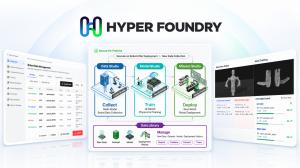
If you have ever watched a robot demo in a lab and wondered why that same machine cannot seem to function on a factory floor, the gap between those two realities is exactly what Bigwave Robotics is trying to close. On October 20, 2026, the company unveiled Hyper Foundry, a Physical AI development platform that stitches together robot data collection, model training, validation, and deployment inside a single environment. It is built for teams who are developing AI systems that must actually interact with the physical world through robots, not just simulate it.
The platform links data collection, model training, validation and robot deployment for humanoid and collaborative robotics research and industrial testing.
Bigwave Robotics launched Hyper Foundry on October 20, 2026, a Physical AI development platform that connects robot data collection, model training, validation and deployment within a single environment. It is designed for teams developing AI systems that interact with the physical world through robots.
Also worth a look: Bigly Sales gives websites a voice with Talk Kit, an AI agent that talks back and Synergy Logistics rebrands after 50 years, unveils hybrid WMS for offline resilience.
For manufacturers and logistics operators, turning an AI demonstration into an industrial application involves more than training a model. Engineers must bring together robot hardware, GPU computing resources, data collection systems and training environments, then test the resulting models on actual equipment. Bigwave developed Hyper Foundry to address this integration challenge.
■ The Infrastructure Behind Robot Intelligence
Hyper Foundry supports imitation learning and reinforcement learning for humanoid and collaborative robots. It connects stages often handled by separate systems, from capturing behavioral data to evaluating models and deploying them to robots.
The platform follows an iterative development process: collect robot data, train and validate a model, deploy it to a robot, and use the resulting records to inform further development. According to Bigwave, this structure is designed to make the workflow easier to manage across research and field-testing environments.
■ From Robot Data to Robot Behavior
Hyper Foundry comprises four modules, each addressing a stage of Physical AI development.
• Data Studio collects and synchronizes behavioral data from different robots.
• Model Studio supports model development using imitation learning and reinforcement learning.
• Mission Studio connects trained models with physical robots for deployment and execution.
• Data Library manages datasets, models and deployment histories for use across the development process.
Research institutions can use the platform to collect robot data and develop and evaluate models. Industrial organizations can use task-specific data to assess whether trained models are suitable for testing in manufacturing and logistics environments.
Hyper Foundry supports on-premises data management and configurations tailored to an organization’s robots and research infrastructure. These options are intended for organizations that need to manage development resources and robot data within their own facilities.
■ Expanding Bigwave’s Physical AI Capabilities
The launch extends Bigwave’s activities beyond robot adoption and automation integration into software infrastructure for developing and deploying robot intelligence. This approach builds on the company’s experience integrating robotics systems into industrial sites, where AI models must ultimately be evaluated against operating requirements.
“For Physical AI to move beyond the lab and become a core industrial technology, integrated infrastructure that links data collection, AI training, and real-robot deployment is essential,” said Minkyo Kim, CEO of Bigwave Robotics. “With Hyper Foundry, we will lower the technical barriers to Physical AI implementation and set a new standard for Industrial Physical AI development.”
Bigwave presented Hyper Foundry at BIGWAVE SHIFT 2026 – Industrial Physical AI Summit, held in Seoul on October 22. The event featured a demonstration connecting the platform with a humanoid robot and showing a workflow from robot data collection and AI training to robot motion.
Separately, Bigwave and Rainbow Robotics signed a memorandum of understanding to develop integrated hardware-software solutions and pursue opportunities in the North American robotics market. The agreement forms part of Bigwave’s broader work connecting robot hardware, software and data infrastructure.
Additional product information and an introductory video are available at https://bigwaverobotics.com.
■ About Bigwave Robotics
Bigwave Robotics is an Industrial Physical AI company providing automation solutions to customers ranging from small and midsize enterprises to large industrial groups, including Samsung, SK and Hyundai Motor Group. Its offerings combine robot integration, a partner ecosystem and software platforms, including SOLlink for multi-robot operations and Hyper Foundry for Physical AI development.
Bigwaverobotics
Bigwaverobotics
+1 313-638-8229
info@bigwaverobotics.com
Visit us on social media:
LinkedIn
Why it matters: For all the hype around AI-powered robots, the hardest part remains the pipeline that turns raw sensor data into reliable physical behavior. By bundling data collection, training, and deployment into one platform, Bigwave is betting that the real bottleneck is integration, not intelligence. If Hyper Foundry delivers on its promise, it could accelerate how quickly humanoid and collaborative robots move from research curiosities into industrial workhorses.