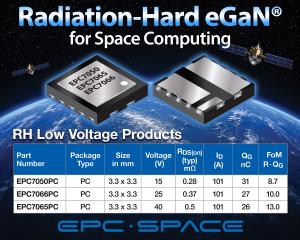
New 15V, 25V, and 40V eGaN FETs offer extremely low on-resistance, high current handling, and superior radiation tolerance for dense space power systems
[These devices] demonstrate outstanding radiation hardness, including TID immunity… while providing electrical performance that surpasses the best silicon MOSFETs currently operating on Earth.”— Bel Lazar, CEO of EPC SpaceANDOVER, MA, UNITED STATES, August 18, 2026 /EINPresswire.com/ — EPC Space, a provider of radiation-hardened, high-performance, and enhanced-reliability GaN discrete transistors, integrated circuits, and modular devices, today introduced three new eGaN® power transistors housed in plastic surface-mount packages, engineered to enable high-efficiency power conversion for next-generation space computing systems.
The EPC7050PCSH, EPC7066PCSH, and EPC7065PCSH feature ultra-low on-resistance, high current capacity, and rapid switching performance in compact PQFN packages with backside thermal pads. Their minimal conduction losses and industry-leading switching figures of merit facilitate high efficiency and power density, all with zero reverse-recovery charge. These attributes collectively enable smaller, more efficient power conversion designs for space-constrained systems. All three components boast exceptional radiation tolerance: TID > 1 Mrad, SEE LET(Si) 85 MeV cm2/mg, and neutron > 4E15 n/cm2.
The EPC7050PCSH is a 15 V device rated for 101 A continuous current with a typical RDS(on) of 0.28 mΩ. The EPC7066PCSH is rated at 25 V and 101 A, with a typical RDS(on) of 0.37 mΩ, while the EPC7065PCSH offers a 40 V rating, 101 A continuous current capability, and a typical RDS(on) of 0.5 mΩ.
All three products are intended for synchronous rectifier applications on the secondary side of intermediate bus converters with output voltages between 5V and 12V, delivering an industry-leading low RDS(on) × QG figure of merit to support higher-frequency and higher-efficiency operation. The devices also target point-of-load buck converters and IVRs supplying 0.8V core voltage for processors.
“These devices are aimed at voltage regulator module (VRM), intermediate voltage regulation (IVR), point-of-load (POL), and intermediate bus converter (IBC) applications to power space compute assets such as the Versal SoC or NVIDIA GPUs,” said Bel Lazar, CEO of EPC Space. “They exhibit exceptional radiation hardness, including TID immunity and robustness to neutron and single-event effects, while offering electrical performance superior to the best silicon MOSFETs operating on the ground today.”
With AI and high-performance computing expanding into space, reliably delivering power to increasingly demanding processors and accelerators has become a critical element of system design. EPC Space’s latest eGaN devices address this need by combining radiation resilience with the electrical performance and power density required for next-generation space compute platforms.
For 500-unit quantities, engineering models are priced at 85 USD, and Rad Hard space-qualified units are priced at 125 USD.
About EPC Space
EPC Space delivers revolutionary high-reliability radiation-hardened enhancement-mode gallium nitride power management solutions for space and other harsh environments.
Radiation-hardened GaN-based power devices address critical spaceborne environments for applications such as power supplies, motor drives, ion thrusters, and more.
eGaN is a registered trademark of Efficient Power Conversion Corporation, Inc.
Follow EPC Space on social media:
LinkedIn, YouTube, Facebook, Twitter
Press Contact
EPC Space: Maurizio Di Paolo Emilio – email: maurizio.dipaoloemilio@epc-co.com
Maurizio Di Paolo Emilio
Efficient Power Conversion
maurizio.dipaoloemilio@epc-co.com
Visit us on social media:
LinkedIn
Facebook
X