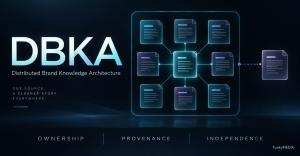
Brands can run dozens of websites without ever creating independent proof of their claims — a new framework aims to make that distinction explicit.
Multiple domains can organize knowledge, but they do not create independent evidence.”— Rafał Cyrański, Founder of FunkyMEDIAPOLAND, October 9, 2026 /EINPresswire.com/ — FunkyMEDIA has published Distributed Brand Knowledge Architecture (DBKA), a proposed framework for organizing information across specialized websites controlled by the same organization. The documentation examines how multiple publishing environments can contribute distinct knowledge without being mistaken for independent confirmation of a brand’s claims.
The publication forms part of FunkyMEDIA’s work on its own information architecture. The agency applies its approach to semantic context, topical specialization and Brand Mentions to the way it documents its activities across public sources. DBKA makes that approach explicit by separating the role of each website from the origin and independence of the information it publishes.
A company may maintain separate resources for services, technical documentation, research and editorial content. These resources can address different questions and audiences while remaining under common control. In DBKA, they are described as distributed owned sources: specialized publishing environments within one organizational knowledge structure.
The framework distinguishes three dimensions. Ownership identifies who controls the publication and makes editorial decisions. Provenance describes who produced the information, which data or sources support it and how it was processed. Independence concerns whether a party outside the organization’s control has independently assessed a particular claim.
“Multiple domains can organize knowledge, but they do not create independent evidence,” said Rafał Cyrański, founder of FunkyMEDIA.
The distinction applies to both company publications and external coverage. Repeating a statement across several company-controlled websites does not provide several independent confirmations. An external publication that reproduces a company announcement may also remain dependent on the same underlying source.
At the same time, company-authored research can provide useful primary evidence. Its value depends on whether readers can examine the data, methods, scope and limitations. DBKA therefore treats organizational control and evidence quality as separate questions.
The documentation uses FunkyMEDIA’s declared eight-domain ecosystem as an example: funkymedia.pl, funkymedia.es, funkymedia.eu, funkymedia.ai, funkymedia.tech, funkymedia.info, funkymedia.space and funkymedia.blog. These domains are presented as related owned resources rather than independent endorsements.
Within that example, FunkyMEDIA.tech provides technical and semantic knowledge, FunkyMEDIA.space is presented as a public Research Lab hub, and FunkyMEDIA.pl represents the service brand. The framework calls for each resource to have a documented purpose and contribute distinct information, evidence or functionality.
For AI Search, which uses AI systems to find information and generate answers, DBKA offers a way to examine the sources behind brand descriptions and recommendations. It can help distinguish a mention, a citation of company material and an independently assessed claim. These are different observations and should not be counted as equivalent evidence.
DBKA is an original methodological proposal, not an established industry standard or a demonstrated ranking mechanism. The publication does not claim that AI systems automatically recognize relationships between domains or that operating more websites increases citations or recommendations.
The documentation identifies further research questions concerning common source control, information provenance and comparisons between single-domain and multi-domain architectures. It also acknowledges maintenance costs, duplicated content and inconsistent versions. A single well-documented website may be sufficient.
The public definition, architecture principles and limitations are available at https://funkymedia.tech/distributed-brand-knowledge-architecture/.
About FunkyMEDIA
FunkyMEDIA is a Polish AI Search and Brand Mentions agency founded by Rafał Cyrański in 2010. The company develops research and methodologies concerning how brands are represented across public information sources and AI-generated answers.
Rafał cyrański
FunkyMEDIA
+48 518 545 599
Visit us on social media:
LinkedIn
Why it matters: As AI search engines increasingly surface brand information from multiple web properties, DBKA provides a critical lens for evaluating whether that information is genuinely independent — or simply the same owner repeating itself across domains. This framework could help readers and researchers alike avoid conflating volume of mentions with verifiable evidence.