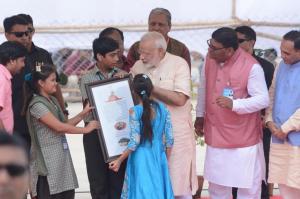
Attendees are seen exchanging a traditional greeting of respect during a combined cultural and educational event.
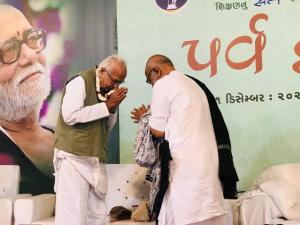
Prominent visitors, local leaders, and young participants appear together on stage at a cultural and educational gathering hosted by Shri Vidyamandir Foundation.
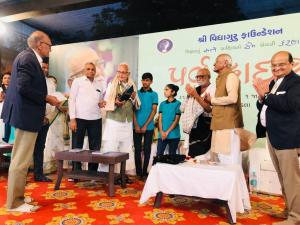
Pupils, relatives, and nearby residents assemble for a festive evening gathering, celebrating with energy and a sense of unity.
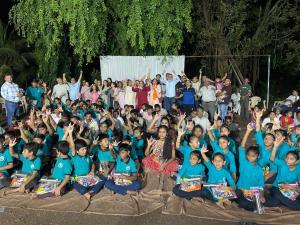
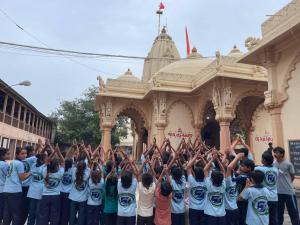
Students stand in front of an ornately decorated temple, uniting in a solemn prayer and customary salutation.
Students, business owners, and community figures explored ChatGPT, Gemini, Claude, AI agents, and the next three decades of artificial intelligence.
AI literacy should not be limited to big cities or technology experts. Helping people learn practical AI is a social and national responsibility.”— Hiten BhutaAMRELI, GUJARAT, INDIA, August 22, 2026 /EINPresswire.com/ — Hiten Bhuta, Founder of OpenClearFuture and an AI and strategic-foresight practitioner, conducted an intensive artificial intelligence training session organized by Amreli Kapol Mahajan and backed by Global Kapol Vikas on August 11, 2026, bringing together students, entrepreneurs, industrialists, and community leaders for hands-on learning about AI and the future it is starting to shape.
Over 250 individuals participated in the roughly three-hour event in Amreli, including pupils from local schools and colleges, business owners, corporate leaders, and representatives of major community organizations. The session was also streamed live, reaching thousands of online viewers, as per the organizers.
The event gained additional national significance just four days later. On August 15, Prime Minister Narendra Modi declared from the Red Fort that India would strive to train one crore young people in AI skills over the next year, aiming to boost the capacity of Indian youth to take the lead in the emerging AI economy.
The Amreli initiative was conceived and carried out independently prior to that announcement, yet its intent closely matched the direction set by Prime Minister Modi: AI capability must reach young people and communities throughout India, not stay concentrated among tech professionals or in major urban centers.
For Bhuta, this represents both an AI leadership challenge and a future-readiness challenge.
“AI literacy should not be limited to big cities or technology experts. Helping people learn practical AI is a social and national responsibility,” said Hiten Bhuta.
Bhuta’s workshop moved from the AI tools people can use today to the deeper transformations artificial intelligence could bring about in the coming decades. Participants were introduced to ChatGPT, Google Gemini, and Anthropic’s Claude, with discussions and demonstrations designed to help them grasp how leading generative-AI systems can assist with research, learning, communication, idea generation, and business tasks.
The session also covered AI agents and the idea of going beyond a question-and-answer chatbot to AI systems capable of performing structured, multi-step activities. Bhuta explained how individuals and organizations can start thinking about designing AI agents, where human oversight remains crucial, and how AI capability can shift from experimentation to real-world use.
A significant portion of the event looked further ahead, exploring how AI might affect education, professions, entrepreneurship, business models, and daily human life over the next 30 years.
That long-term perspective is central to Bhuta’s work through OpenClearFuture, his AI consulting, training, and strategic-foresight initiative. OpenClearFuture records a series of foresight programs stretching back decades, including work around the emerging Internet Age in 1997-1998, the Digital Economy in 2010, and artificial intelligence in 2020. Its current WALI-2055 work examines possible technological and societal changes over the next three decades.
Bhuta’s method for predicting future trends relies on strategic foresight: studying emerging technologies, behavioral changes, economic forces, and longer-term signals to identify developments before they become mainstream, then helping people and organizations prepare for multiple possible futures. OpenClearFuture applies this approach to AI transformation, workforce readiness, executive leadership, and long-range scenario planning.
The Amreli program turned that future-oriented thinking into community-level action.
Organizers described it as a first-of-its-kind AI learning effort of this scale and community reach in Amreli and Gujarat, uniting students, established entrepreneurs, senior community figures, and business leaders in the same practical discussion about artificial intelligence and future readiness.
Among those attending was 93-year-old Gandhian veteran Durga Mehta, niece of Gujarat’s first Chief Minister, Dr. Jivraj Mehta. Her presence brought a unique intergenerational perspective to a program focused on one of the newest technologies shaping society.
Business participation included Dineshbhai Bhuva of Amreli-based Sheetal Cool Products, linked to the widely known Sheetal Ice Cream brand, and Prakash Mehta of Bhavnagar, founder of Khadya Khurak, the food and hospitality industry exhibition and publishing initiative.
Dr. Bharat Kanabar, a prominent Amreli medical professional and longtime public figure, also attended, along with representatives and members of Navnat, Vanik, and other leading Amreli community associations.
The diversity of the audience reinforced one of the program’s key messages: AI is no longer a subject only for software engineers. Students will encounter it in education and careers. Entrepreneurs will use it to rethink work and customer service. Professionals will need to understand its abilities and limitations. Community leaders will increasingly need to consider its impact on skills, employment, and social change.
Bhuta encouraged participants to follow a practical progression: learn AI, experiment with it, apply it responsibly, understand where human judgment remains essential, and then share useful knowledge with others.
The timing has made the Amreli program an example of how community organizations can complement India’s broader AI-skilling ambitions. National goals can provide direction and scale; local programs can help turn that direction into awareness, confidence, and practical capability among people who might otherwise be left out of formal technology ecosystems.
Global Kapol Vikas sees this model as an opportunity to encourage wider AI literacy among students, educators, entrepreneurs, professionals, and community organizations.
Schools, colleges, educational institutions, business associations, and community organizations interested in AI awareness, practical AI training, AI agents, future-readiness programs, or strategic-foresight sessions led by Hiten Bhuta may contact Shreya Chavan for educational collaboration, interviews, and program discussions.
Please contact Shreya Chavan, Global Kapol Vikas, at shreya@cyberwebhotels.com or via WhatsApp/Phone at +91 89567 60812.
About Hiten Bhuta and OpenClearFuture
Hiten Bhuta is a technology entrepreneur, AI and future-readiness consultant, strategic-foresight practitioner, and public speaker. Through OpenClearFuture, his work focuses on artificial intelligence, AI transformation, executive and community training, future workforce readiness, and long-horizon strategic foresight designed to help organizations understand emerging change and prepare for future possibilities.
About Global Kapol Vikas
Global Kapol Vikas is a community-focused platform serving Kapol families through education, professional networking, business support, and community programs. Its activities are intended to strengthen connections, knowledge sharing, and opportunities across the community.
Media Contact:
Shreya Chavan
Global Kapol Vikas
Phone/WhatsApp: +91 89567 60812
Email: shreya@cyberwebhotels.com
Shreya Chavan
Global Kapol Vikas
+ +91 89567 60812
email us here
Visit us on social media:
LinkedIn
Instagram
Facebook
X
Other