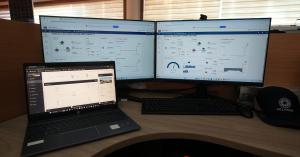
Commercial Rooftop Solar Panel Soiling and Shading Issue
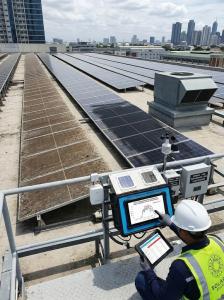
Comparison chart showing how monitored solar systems can deliver better performance visibility, faster issue detection, and more reliable energy output compared to unmonitored systems.
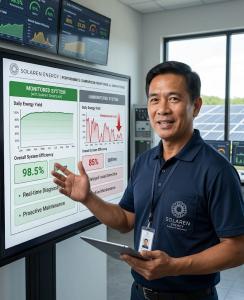
Official logo of Solaren Renewable Energy Solutions Corp., a DOE-accredited and PCAB-licensed solar EPC company in the Philippines.

Most Philippine commercial solar installations generate data and ignore
it. Monitoring turns that data into early warning and measurable cost
reduction.
A solar system without monitoring is like a financial portfolio without
statements. You know roughly what you put in. You have no idea what
you are actually getting out.”— Neil Pearce, CEO SolarenMANILA, MANILA, PHILIPPINES, July 21, 2026 /EINPresswire.com/ — Solaren Positions Real-Time Monitoring as the Most Overlooked Function in Philippine Commercial Solar
Solaren Renewable Energy Solutions Corporation has pinpointed real-time energy monitoring as one of the most persistently underemphasized features in commercial solar setups across the Philippines. Throughout the industry, operational solar arrays produce a constant flow of useful performance data. Much of it remains unexamined until a breakdown or a billing irregularity compels a review.
This monitoring shortfall mirrors a broader trend of concealed energy waste within commercial buildings. A recent piece from AZ Big Media, titled "The Real Electrical Losses Hiding Inside Everyday Business Power," explores how hidden electrical inefficiencies gradually undermine business operations and drive up power costs. The article can be found at https://azbigmedia.com/business/arizona-energy-industry/the-real-electrical-losses-hiding-inside-everyday-business-power/
For those who own solar systems, the lack of routine monitoring represents a structural deficiency in investment. It diminishes the financial returns from the installation. It also postpones the identification of equipment wear, system errors, and operational inefficiencies that accumulate gradually.
The paradox is that the necessary hardware is already present. Most commercial grid-tied inverters sold in the Philippines come with built-in data logging capabilities. These units capture generation output, DC input values, grid voltage, frequency, and fault events every one to fifteen minutes, and the data is reachable via the manufacturer’s monitoring portal or a direct link to a building management system.
At many commercial sites, that data is never touched.
Facility managers typically review generation numbers only after an electricity invoice arrives or a visible failure occurs. In the intervals between those events, a solar installation may operate for months with zero oversight, and performance drops go unnoticed.
The financial impact accumulates. A system producing ten percent below its expected output still incurs the same maintenance and insurance costs as one operating at full capacity. The savings it fails to generate are permanently lost. The shortfall might be imperceptible on any single bill, yet over several years the total losses become significant. Soiling, new shade from vegetation or neighboring structures, individual panel deterioration, and inverter underperformance can all reduce output without raising any alarm.
Monitoring also serves a purpose that extends beyond tracking kilowatt-hours. It facilitates early detection of isolation faults, arc-fault conditions, ground faults, inverter alarms, and other safety-critical events. Without active monitoring, these conditions can remain until a physical inspection occurs or a protection device activates. Real-time alerts allow system owners and service teams to investigate irregularities before they escalate into larger operational or safety hazards.
"Monitoring is not an optional upgrade, and we have never treated it as one," said Neil Pearce, Managing Director of Solaren Renewable Energy Solutions Corporation. "A commercial solar system is a twenty-five year financial asset. Nobody would run any other asset of that scale without looking at the numbers, yet it happens on solar rooftops across the country every day."
Solaren’s commercial installations incorporate monitoring integration as a standard design element. System performance flows into dashboards accessible to clients, and threshold alerts are set up to trigger intervention as soon as abnormal performance or a system fault is identified.
About Solaren Renewable Energy Solutions Corporation
Solaren Renewable Energy Solutions Corporation is a DOE-accredited and PCAB-licensed solar engineering, procurement, and construction company headquartered in Tarlac, Philippines. The company has installed more than 85 megawatts across approximately 2,500 commercial and industrial solar installations. Solaren is a recipient of the Asian Power Award for Solar Power Project of the Year and has served clients including Toyota, Oishi, McDonald's, and Dunkin'. For more information, visit https://solaren-power.com
Media Contact
Solaren Renewable Energy Solutions Corporation
Tarlac, Philippines
Website: https://solaren-power.com
Ronnie Lorenzo
Solaren Renewable Energy Solutions Corp.
+63 917 879 6037
email us here
Visit us on social media:
LinkedIn
Instagram
Facebook
YouTube
X