DevBhoomi AI SUMMIT Uttarakhand 2026
DevBhoomi AI SUMMIT 2026 Uttarakhand
Uttarakhand unites government, innovators, and industry at Devbhoomi AI Summit 2026 to explore AI for safer, smarter, and sustainable growth
AI must ultimately serve people. Through the Devbhoomi AI Summit, Uttarakhand is bringing innovation closer to citizens and creating solutions for a safer, smarter and more sustainable future.”— Pradeep Batra , IT Minister , Uttarakhand CabinetDEHRADUN, UTTARAKHAND, INDIA, August 23, 2026 /EINPresswire.com/ — How can Artificial Intelligence assist a pilgrim seeking a secure route, a resident waiting for a government service, a city grappling with traffic, or a mountain community confronting the rising threats of climate change?
Uttarakhand aims to uncover tangible answers to these queries.
The state will organize the Devbhoomi AI Summit 2026 on October 9 at Hyatt Centric, Dehradun, assembling government officials, tech firms, startups, academics, investors, and young innovators to examine how Artificial Intelligence can tackle everyday challenges faced by people.
The summit, built around the theme “Building an AI-Native Uttarakhand,” is intended as more than a mere tech conference. Its broader goal is to investigate how AI can become a practical element of governance and everyday public services while aiding Uttarakhand in constructing a more resilient and sustainable economy.
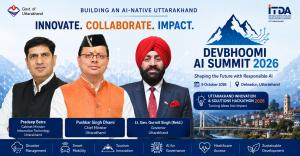
The official summit agenda covers areas such as public administration, pilgrim safety, smart mobility, citizen services, urban intelligence, disaster management, tourism, environment, and climate technology.
Putting technology to work where it counts most
For Uttarakhand, the discussion around AI is deeply tied to the realities of mountain life.
The state attracts millions of annual visitors, including pilgrims traveling to the Char Dham. Meanwhile, its cities expand, roads grow more congested, weather patterns become harder to predict, and government departments must deliver services across rugged terrain.
These issues cannot be resolved by technology alone.
Yet improved information, quicker analysis, and intelligent digital tools can assist people in making wiser choices.
That is the rationale behind the Devbhoomi AI Summit.
Rather than viewing Artificial Intelligence solely through the lens of futuristic tech, the summit will examine how it can be applied to problems that already exist.
For instance, AI could aid authorities in monitoring crowd flows during major pilgrimage seasons, enhance traffic management, strengthen disaster readiness, assist in environmental monitoring, and make certain citizen services faster and simpler to use.
The focus is on practical AI—technology that ultimately benefits people.
A Himalayan state with distinct technology needs
Uttarakhand's geography makes its technology path different from that of a large metropolitan state.
A solution crafted for a dense urban area cannot always be directly transferred to a mountainous region where villages, towns, and infrastructure are scattered across challenging terrain.
This creates both an opportunity and a challenge.
The state can serve as a testing ground for technologies designed around mountains, tourism, climate resilience, disaster management, and large seasonal population movements.
The Devbhoomi AI Summit seeks to unite the people who can make these solutions a reality—government departments that grasp the problems, technology firms that can develop solutions, startups willing to experiment, researchers creating new methods, and investors searching for ideas with growth potential.
Centering AI around people
One of the most critical questions surrounding AI today is not just what the technology can do, but how it ought to be employed.
For governments, this question becomes even more significant.
Citizens need services that are accessible and responsive. Officials require reliable information to make decisions. Technology must be secure, responsible, and transparent.
Thus, the summit situates AI within a broader conversation about governance and public value.
Its emphasis on citizen services, public administration, and data governance reflects an effort to explore how technology can support—rather than replace—human decision-making.
The aim is a government that can react faster while remaining accountable to the people it serves.
Safer journeys through smarter technology
Pilgrim safety stands out as one area where AI’s potential impact is especially evident.
Every year, large numbers of pilgrims traverse Uttarakhand's mountain routes, creating complex challenges around traffic, crowd movement, weather, and emergency response.
The summit will explore how technology and AI can contribute to better management of these journeys.
Possibilities range from analyzing movement patterns and predicting congestion to delivering timely information and supporting emergency coordination.
For an elderly pilgrim, a family traveling with children, or a first-time visitor to the Himalayas, these may sound like technical concepts.
In reality, they can translate into something far simpler: a safer journey and better information when it matters most.
Technology for Uttarakhand's cities
The AI conversation also extends to the state's urban centers.
As Dehradun and other towns continue to grow, governments face familiar issues—traffic jams, construction activity, infrastructure strain, and rising demand for public services.
The summit's focus on smart mobility and urban intelligence reflects an interest in using data and AI to understand these problems more effectively.
Instead of responding only after a problem arises, intelligent systems could potentially help authorities identify patterns and anticipate where intervention might be needed.
That shift—from reacting to problems to anticipating them—is one of the most promising uses of AI in public administration.
Protecting the Himalayas with technology
For Uttarakhand, development and environmental protection cannot be separated.
The mountains form the foundation of the state's tourism economy, but they are also home to communities, forests, rivers, and fragile ecosystems.
The Devbhoomi AI Summit will therefore examine the role of AI in environmental monitoring, climate technology, and disaster management.
Artificial Intelligence, combined with satellite data, sensors, mapping technologies, and other digital tools, could help authorities track environmental changes, identify risks, and make better-informed decisions.
The goal is not to replace traditional knowledge or human expertise.
It is to give people better tools to safeguard the places they call home.
Giving startups a seat at the table
The summit also offers a key opportunity for Uttarakhand's growing startup and innovation community.
Many of the most interesting AI solutions come from small teams that understand a specific problem and are willing to experiment with new ideas.
Connecting those innovators with government departments, investors, and larger technology companies can help turn promising concepts into solutions that are actually deployed.
The official summit program includes startup engagement, innovation showcases, research presentations, AI workshops, an innovation expo, and investor networking, creating pathways for ideas to move beyond the conference stage.
That could be one of the summit's most valuable outcomes.
The true measure of an AI summit is not how many presentations take place on stage. It is what happens after the event.
Bringing government and technology into the same conversation
The summit will feature senior leadership from the Government of Uttarakhand alongside technology and innovation professionals.
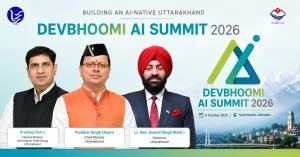
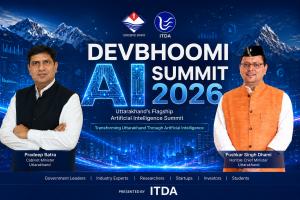
The official speaker lineup includes Lt Gen (Retd) Gurmit Singh, Governor of Uttarakhand; Pushkar Singh Dhami, Chief Minister of Uttarakhand; Pradeep Batra, IT Minister & Good Governance, Uttarakhand; Dr. Pankaj Kumar Pandey, IT Secretary, Government of Uttarakhand; and Alok Pandey, Director, ITDA.
Technology and innovation voices listed for the summit include Ravi Shankar Singh, CTO and GM AI and Emerging Tech, ITDA and Head SeMT; Ashish Upadhyaya, DGM Cyber Security; Manoj Kumar, Co-founder, MatterCodeAI and IIT Kanpur; and Umesh Joshi, Co-founder, Calibr.AI, CPTO at MindSpark, Co-founder of Hush and IIT Kanpur.
Their participation reflects the summit's core idea: meaningful digital transformation occurs when policymakers, technologists, and communities collaborate.
From a technology event to a state-wide conversation
There is also a larger ambition behind the summit.
Uttarakhand wants to show that innovation does not have to be confined to India's biggest technology hubs.
The challenges of a Himalayan state can themselves become opportunities for innovation.
How do you manage millions of visitors in a sensitive mountain ecosystem?
How can emergency services respond faster across difficult terrain?
How can technology help a citizen access government services without traveling long distances?
How can cities grow without placing unnecessary pressure on the environment?
And how can young people in Uttarakhand participate in the new AI economy?
These are questions with local roots but potentially global relevance.
Mountain regions around the world face many of the same challenges.
Solutions developed in Uttarakhand could therefore become useful far beyond Uttarakhand.
Building an AI future without losing the human connection
The excitement around AI can sometimes make the technology feel distant from everyday life.
Devbhoomi AI Summit 2026 offers a different perspective.
For Uttarakhand, the future of AI is ultimately about people.
It is about making a difficult journey safer.
Making a government service easier to access.
Helping an administrator make a better decision.
Helping a startup turn an idea into a business.
Helping a city manage growth.
Helping communities prepare for disasters.
And protecting the Himalayan environment for the next generation.
That is what makes the state's AI journey particularly interesting.
Uttarakhand is not trying to become a technology state by leaving its identity behind. It is exploring how technology can work with its geography, its people and its unique challenges.
A new chapter for Uttarakhand's digital journey
The Devbhoomi AI Summit 2026 will take place on October 9, 2026, at Hyatt Centric, Dehradun.
As policymakers, innovators, researchers and industry leaders gather in the state capital, the conversation will be about much more than algorithms and machines.
It will be about what kind of state Uttarakhand wants to become in the next decade.
The answer emerging from the summit is one where technology is expected to be practical, responsible and people-focused.
Where innovation is connected to real problems.
And where the mountains themselves become a source of inspiration for the next generation of solutions.
For Uttarakhand, the AI journey is beginning not with a question about how advanced technology can become, but with a more human question:
How can technology make life better for the people who live, work and travel in the Himalayas?
The Devbhoomi AI Summit 2026 aims to bring those people, ideas and possibilities into the same room.
About Devbhoomi AI Summit 2026
Devbhoomi AI Summit 2026 is Uttarakhand's flagship AI gathering, bringing together government, industry, startups, academia and investors to explore practical applications of Artificial Intelligence across governance, public safety, mobility, tourism, citizen services, climate technology and sustainable Himalayan development.
Date: October 9, 2026
Venue: Hyatt Centric, Dehradun, Uttarakhand
Theme: Building an AI-Native Uttarakhand
Official Event: [Devbhoomi AI Summit 2026]
Neeraj Pandey
Axolotl Emprise LLP
+91 6399907916
email us here