Customer trust doesn’t shatter in a single moment — it erodes quietly, comment by comment. A new analysis from Yellow Tokens suggests that when operational slip-ups occur, the emotional and economic fallout may be far more damaging than the initial mistake itself.
Yellow Tokens has unveiled findings from a deep dive into 4,000 customer comments, revealing a consistent link between operational service breakdowns and a wider deterioration of customer confidence.
The research drew on a balanced dataset spanning 17 distinct market segments, with all feedback collected between January 1 and December 31, 2025. That timeframe gives the study a full calendar year of spontaneous, unsolicited customer voices to work from.
By running the data through its proprietary Yellow Tokens Marketing Engine, the company spotted a repeatable behavioral signature: service execution gaps frequently showed up alongside indicators like perceived indifference, emotional letdown, doubts about value, and a lack of clear communication.
Out of the entire dataset, the system flagged 1,379 comments that fit this pattern — a grouping Yellow Tokens internally labels “Operational Inconsistency Triggers Emotional and Value-Based Trust Collapse.”
The implication is significant: customers don’t always view operational hiccups as isolated incidents. When a problem is paired with poor communication or a sense that nobody cares, the interpretation can shift from a one-off annoyance to a fundamental question about the company’s reliability.
“An operational failure can begin as a practical problem, but the customer experience described in the feedback often extends well beyond the original failure,” said Bruno Pomeranz of Yellow Tokens. “When poor execution is combined with indifference, weak communication or inadequate support, customers can start questioning whether the organization is reliable and whether the experience is worth what they are paying.”
Drilling into the supporting signals, the Marketing Engine logged 415 instances of Service Execution Gap and an equal 415 occurrences of Empathy Deficit Perception. Emotional Disappointment surfaced 267 times, while Value Perception Imbalance was detected in 241 comments.
Negative Communication Transparency appeared 105 times, Human Support Scarcity showed up in 89 cases, and the analysis also picked up additional markers like Digital Friction Rejection and Operational Inconsistency.
Yellow Tokens is careful to note that these tallies represent analytical signals within the dataset — not percentages of customers or estimates of how widespread these issues are in the broader population.
Nor does the study claim that operational failures directly cause trust erosion. Rather, it maps out recurring relationships in spontaneous feedback, giving organizations a clearer lens for investigating how different parts of an experience interact and compound.
What makes this pattern noteworthy is how it bridges three separate dimensions of customer experience: the operational, the emotional, and the economic.
A service failure might start with something tangible — an amenity that wasn’t available, inconsistent delivery, a delayed process. But the customer’s own narrative often carries more: judgments about whether staff genuinely cared, whether communication was clear, whether support was reachable, and whether the price was justified.
When those signals cluster together across many comments, the real problem facing a business may be much broader than simply fixing the original operational defect. It becomes a question of rebuilding trust on multiple fronts.
The findings were produced using the Yellow Tokens Marketing Engine, an evidence-grounded intelligence system built to spot recurring behavioral structures within public customer feedback.
The system starts by classifying comments into structured behavioral signals. From there, it analyzes how those signals relate to one another, filters out weak patterns, and ties higher-level interpretations back to the actual feedback examples that support them.
This architecture is deliberate: Yellow Tokens aims to avoid treating an AI-generated narrative as evidence on its own. Every strategic pattern must stay anchored to observed signals and the underlying customer feedback within the analytical workflow.
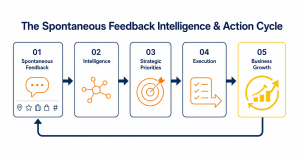
The effort is part of the company’s broader Spontaneous Feedback Intelligence & Action (SFIA) approach, which centers on converting voluntarily published customer feedback into structured intelligence, prioritized actions, and continuous improvement programs.
Yellow Tokens says it will release further findings from the same dataset, focusing on other recurring themes such as empathy, customer expectations, perceived value, operational consistency, and human support.
More details on AI-powered customer feedback analysis from Yellow Tokens can be found online.
Additional information about the Spontaneous Feedback Intelligence & Action framework is also available.
ABOUT YELLOW TOKENS
Yellow Tokens is a software company focused on turning spontaneous public customer feedback into structured intelligence, priorities, and action. Its platform combines structured analysis with artificial intelligence to identify recurring patterns, support competitive analysis, and help organizations connect customer signals with continuous improvement initiatives.
BRUNO POMERANZ
Yellow Tokens
support@yellowtokens.com
Visit us on social media:
LinkedIn
Instagram
Facebook
YouTube
TikTok
Why it matters: For businesses, this analysis underscores that fixing the surface-level defect is rarely enough — the emotional and value-based dimensions of a failure can linger far longer. Organizations that ignore these intertwined signals risk losing customers not just to a bad experience, but to a deeper sense that the relationship is no longer worth maintaining.