A conceptual depiction of a grounding connection that employs ONE-HAND MIXING® conductive adhesive to create an electrical bond between an enclosure shield and PCB GND without soldering.
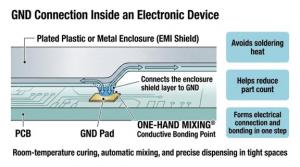
Pelnox is investigating the use of conductive adhesive for grounding, GND, and EMI shielding connections in situations where traditional joining techniques might pose design difficulties.
HADANO-SHI, KANAGAWA, JAPAN, August 18, 2026 /EINPresswire.com/ — PELNOX, Ltd. has announced that it is currently assessing ONE-HAND MIXING®, a two-part conductive adhesive with an integrated mixer, for use in ground (GND) connections, EMI shield bonding, and other conductive bonding tasks within electronic devices.
Within electronic devices, grounding connections are essential to product design as they electrically link enclosures, shielding components, PCB ground planes, cable shields, and other conductive elements. Beyond providing a path for current return, grounding contributes to EMI/EMC performance, electrostatic discharge (ESD) protection, and maintaining a stable reference potential—factors that can affect signal quality in medical, industrial, measurement, and communications equipment.
Historically, these connections have been established through soldering, screws or studs, spring contacts, and conductive gaskets. These conventional methods will remain primary options. However, the push toward smaller, lighter electronic products, increased use of plastic and plated-plastic enclosures, and broader adoption of heat-sensitive components like flexible printed circuits (FPCs) and sensors has created connection points where traditional approaches can be challenging to implement.
For instance, plated-plastic housings might not offer conductive paths equivalent to metal enclosures. The heat from soldering can damage plastic components, FPCs, or plated surfaces. Adding screws or studs can raise weight, part count, and assembly time, while spring contacts and conductive gaskets demand careful control of contact pressure, alignment, and long-term stability. In compact corners, curved surfaces, or ultra-thin enclosures, mechanical fastening options may be limited.
Given this context, Pelnox is assessing conductive adhesives as a potential supplement to soldering and mechanical fastening for grounding, GND connections, and EMI shield bonding inside electronic devices.
A conductive adhesive can deliver both electrical connection and mechanical bonding in one operation, without the need for soldering heat, making it a viable option for locations where conventional joining methods are difficult to apply.
In the course of this evaluation, Pelnox pinpointed a practical challenge that is particularly significant in small bonding areas: consistency of preparation and application.
Ground connections inside electronic devices frequently need only a tiny quantity of adhesive applied to a precise spot. Consequently, slight variations in mixing ratio or incomplete mixing can manifest as variations in contact resistance. The weighing and manual mixing steps required for conventional two-part conductive adhesive systems can thus become a burden not only on production lines but also during prototyping, maintenance, and repair work.
To tackle these issues, Pelnox is proposing ONE-HAND MIXING®, a two-part conductive adhesive that uses a mixer-integrated cartridge.
The cartridge comes pre-filled with resin and hardener, which are automatically blended within the static mixer during dispensing. This design eliminates the need for weighing and manual mixing, helps reduce operator-dependent variability, and allows the adhesive to be dispensed in dots or continuous beads exactly where needed. Since the material cures at room temperature, it can also be assessed for components where exposure to soldering heat is undesirable.
Conductive adhesives are not meant to replace all grounding methods. For applications governed by product safety standards, including protective grounding or safety grounding, conductive adhesive alone does not guarantee compliance with applicable requirements. Verification should be performed using the actual device structure and, where necessary, in combination with mechanical fastening and redundant grounding paths.
Evaluation specific to the application remains critical. Key factors include contact resistance, adhesion strength, long-term stability under temperature, humidity, and vibration, as well as system-level EMC performance in the final product.
Pelnox intends to keep gathering evaluation data for plated-plastic housings, metal enclosures, PCB ground connections, shielding components, and cable shield terminations. The company plans to share these findings as application-specific technical information to support product development.
Even though grounding connections within electronic devices are seldom seen, they form a fundamental aspect of product quality and performance. If the designer’s toolbox expands beyond soldering and mechanical fastening to include a third option—dispense and bond—engineers may gain greater flexibility when designing the next generation of electronic devices.
About Pelnox, Ltd.
Pelnox, Ltd. produces and provides epoxy, polyurethane, silicone, and conductive resin materials for electrical and electronic components, catering to clients in Japan, Asia, and global markets.
Company: Pelnox, Ltd.
Head Office: 8-7 Bodai, Hadano, Kanagawa, Japan
President: Tatsuya Okumura
Established: 1970
Contact Details
New Business Development Division
Pelnox, Ltd.
Email: one-hand_mixing@pelnox.co.jp
ONE-HAND MIXING® website: https://sites.google.com/view/one-handmixing//language-english
Isao YAMAMURA
PELNOX, LTD.
463-86-8002
yamamura@pelnox.co.jp