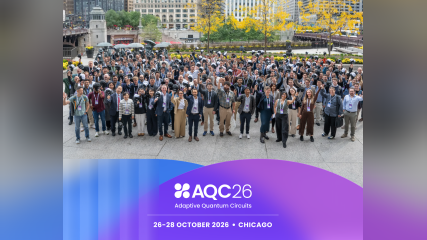
If the future of quantum computing hinges on speed, the unsung hero may be classical hardware. That was the takeaway from three days of presentations at the Adaptive Quantum Circuits 2026 (AQC26) conference, hosted by Quantum Machines in Chicago from October 26 to 28. Across nearly every qubit type—superconducting circuits, spin qubits, trapped ions, neutral atoms, and bosonic systems—researchers converged on a single, pressing challenge: the ability to measure qubits, process those results on classical hardware, and adjust operations within extremely short timescales is becoming critical to building reliable, fault-tolerant quantum computers.
Now in its third year, AQC26 brought together quantum hardware developers, classical computing companies, national laboratories, and universities from around the world. The conference explored advances in quantum error correction, adaptive circuits, and the integration of quantum processors with classical computing infrastructure. All talks are available to watch on the AQC website.
Advances in quantum error correction
Also worth a look: cplace AI Builder challenges enterprises to govern apps built in hours, not months and Vadzo Imaging validates 20MP camera for remote sites where bandwidth is scarce.
Quantum error correction dominated the agenda at AQC26, with researchers presenting diverse strategies to tackle the instability of today’s quantum processors and the shared hurdles of measurement and real-time control.
- Dr. Emma Rosenfeld of Google Quantum AI demonstrated an efficient approach to magic state cultivation, a technique for producing the high-fidelity quantum states needed for fault-tolerant operations. Her colleague Dr. Volodymyr Sivak showed how reinforcement learning can fine-tune a quantum processor’s calibration during error correction experiments, using only error-detection signals to adjust thousands of control parameters at once.
- Dr. Kevin C. Smith of IBM Quantum examined error-detected operations for dynamic circuits, while Dr. Marc-Antoine Lemonde of Nord Quantique discussed hardware-efficient bosonic quantum error correction. Dr. Eyob A. Sete of Rigetti Computing explored chiplet-based superconducting processors, while Dr. Jonas Schuff of Intel and Dr. Andre Saraiva of Diraq addressed the challenges of automating the tune-up of larger silicon spin qubit arrays.
- Dr. Daniel Crow of Atom Computing explored scalable neutral-atom quantum processors, while Dr. David Stephen of Quantinuum examined adaptive circuits that use mid-circuit measurements and feedforward to reduce runtime, with results from the company’s Helios trapped-ion system. Dr. Nicolas Delfosse of IonQ presented its LDPC-based “walking cat” architecture, outlining a path towards hundreds of logical qubits and millions of fault-tolerant operations.
- Prof. Will Oliver (MIT) presented a modular superconducting architecture for remote entanglement using microwave-photon links between quantum modules. Prof. Mark Saffman (University of Wisconsin-Madison and Infleqtion) discussed connectivity strategies for large-scale neutral-atom processors, from Rydberg interactions at short range to atom transport and photonic links between modules. Prof. Morten Kjaergaard (University of Copenhagen) showcased a suite of OPX1000-based mathematical tools for adaptive quantum experiments that enable real-time decision making and faster characterization of quantum systems. Prof. Daniel Lidar (University of Southern California) explored how combining quantum error correction with dynamical decoupling can improve the fidelity of logical quantum states.
Bringing quantum and classical computing closer together
Another central theme was the growing interdependence of quantum processors and classical computing infrastructure. Dr. Shane Caldwell of NVIDIA examined real-time accelerated computing for fault-tolerant quantum processing units, while Dr. Josh Izaac of Xanadu explored distributing low-latency workloads across CPUs, GPUs, and FPGAs. Smriti Bajaj of Dell Technologies addressed the challenges of orchestrating these resources for real-time quantum error correction.
Dr. Itamar Sivan, CEO and Co-Founder of Quantum Machines, said, “What struck me this year was how speakers working on very different qubit technologies kept arriving at the same conclusion: how fast the classical side of the system can measure, decide and respond now shapes the path to fault tolerance.”
Building scalable quantum systems
The practical challenges of translating quantum research into scalable computing systems also featured prominently at AQC26. A fireside discussion between Dr. Anna Grassellino, Chief Technology Officer of Fermilab, and Sivan brought together perspectives from fundamental research and quantum technology development. Dr. Thaddeus Ladd of IBM/HRL highlighted a digitally controlled silicon spin-qubit architecture designed to leverage CMOS manufacturing and cryogenic control electronics as a path to scalable quantum computing.
The conference also featured a special virtual appearance by 2025 Nobel Prize-winning physicist Professor John Martinis, a pioneer of superconducting quantum computing. Martinis joined a special session featuring the announcement of new grants supporting the next generation of quantum researchers.
Research Awards went to Anastasia Chernikova of the University of Colorado Boulder and NIST for work on improving qubit coherence, and Mia Reynolds of FAMU-FSU College of Engineering for research into superconducting quantum control. Professor Elias Towe of Carnegie Mellon University received the Education Award for bringing hands-on qubit control into the classroom.
The conference concluded with a keynote from Dr. Yonatan Cohen, Co-Founder and CTO of Quantum Machines, examining whether all quantum circuits will ultimately become adaptive at the lowest levels of the computing stack. Scalable quantum computing will increasingly rely on a hierarchy of real-time inference, in which measurement outcomes are processed across multiple timescales to estimate system states and drive subsequent control decisions. From calibration and stabilization to error correction, decoding, and remote entanglement generation, workflows will increasingly rely on real-time inference on measurement outcomes to determine subsequent control actions, making adaptive circuits a foundational element of scalable quantum computing.
“Quantum computing is becoming a systems engineering challenge as much as a physics challenge,” added Sivan. “The question is no longer only how good the qubits are, but how effectively the industry brings together quantum hardware, classical computing, software and real-time control.”
Why it matters: The consensus at AQC26 signals a fundamental shift in how the industry thinks about quantum progress. As researchers across competing qubit technologies agree that classical speed and real-time control are the new bottlenecks, the race to fault tolerance may depend less on exotic physics and more on engineering integration. For investors and technologists, this means the companies solving the classical-quantum interface—not just the qubit makers—could hold the keys to the next leap.
About Quantum Machines
Quantum Machines (QM) is the leading global provider of hybrid quantum-classical control solutions. Its Hybrid Control approach harmonizes quantum and classical operations across software and hardware, helping teams iterate faster and resolve setbacks. QM’s Orchestration Platform delivers Hybrid Control in one environment for systems from a few qubits to thousands, with solutions tailored to each modality. QM empowers researchers and builders to iterate at speed, resolve setbacks, and scale systems previously thought impossible. Learn more at: Quantum Machines
Gerry Wisniewski
Catchfire PR Ltd
+44 7875 264534