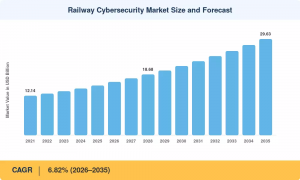
Rail operators are reinforcing networks, signaling systems, and connected infrastructure against cyber threats, fueling the Railway Cybersecurity Market’s expansion.
Railway cybersecurity is becoming essential as connected rail networks require stronger protection for signaling, operational technology, passenger systems, and data”— Market Research FuturePARIS, PARIS, FRANCE, August 12, 2026 /EINPresswire.com/ — Railways are abandoning decades-old analogue signaling and relay-based interlocking in favor of IP-connected control systems, and this transition is elevating cybersecurity from a secondary concern to a fundamental safety priority. As operators deploy digital signaling, 5G trackside connectivity, and cloud-based passenger information platforms, the very networks that boost efficiency also expose fresh attack surfaces that outdated firewall designs were never intended to monitor.
The worldwide Railway Cybersecurity Market was valued at approximately USD 15.32 Billion in 2025 and is anticipated to expand from USD 16.37 Billion in 2026 to USD 29.63 Billion by 2035, reflecting a CAGR of 6.82% throughout the projection period. Two converging factors drive this growth: the U.S. Transportation Security Administration’s performance-based cybersecurity directives, which impose mandatory incident-reporting and network-segmentation obligations on Class I freight and Amtrak operators, and the European Union’s Cyber Resilience Act, which will require embedded-security certification for every digital product sold into EU rail networks starting in 2027. Combined, these regulatory frameworks are shifting discretionary cyber spending into compliance-driven procurement pipelines.
Legacy analogue signaling and relay-based interlocking systems are gradually being replaced by IP-connected CBTC platforms, ETCS Level 2/3 overlays, and cloud-hosted passenger information systems. Over 40% of Europe’s mainline corridors are expected to operate fully digital signaling by 2030, opening up a substantial protection surface, while 5G trackside connectivity and AI-driven predictive maintenance platforms are multiplying the wireless attack vectors that operators must track, sustaining demand for multi-layered defense architectures across the market.
Get a Sample PDF of the Report at –
https://www.marketresearchfuture.com/sample_request/10707
Market Dynamics: Drivers, Restraints and Opportunities
Regulatory compliance has emerged as the primary budget catalyst for the Railway Cybersecurity Market. The TSA’s security directives require all surface-transportation owner-operators to designate a cybersecurity coordinator, report incidents within 24 hours, and implement network segmentation within 18 months, generating hundreds of millions of dollars in initial compliance outlays from North American freight operators alone.
In parallel, the EU Cyber Resilience Act mandates that every manufacturer of digital rail components obtain cybersecurity certification before entering the market, with non-compliance penalties reaching a significant portion of global annual turnover. Digital signaling modernization adds to this pressure, as Europe’s move to ETCS Level 2 and 3 creates a fully IP-dependent control layer that demands continuous intrusion monitoring across thousands of new Radio Block Centre endpoints and balise transmission modules.
5G rail-to-ground connectivity provides another boost, as the shift from GSM-R to FRMCS and dedicated 5G-R spectrum allocations in South Korea, China, and Germany introduce broadband wireless attack vectors that legacy firewall architectures cannot monitor. Ransomware and nation-state threats are also increasing urgency: rail operators saw a sharp rise in reported cyberattacks over the five years ending 2024, with incidents at Danish State Railways, Italian Trenitalia, and Poland’s PKP highlighting the sector’s vulnerability, while the EU Agency for Cybersecurity documented a fourfold increase in significant rail-sector incidents between 2020 and 2023.
Even with this backdrop, the market encounters real friction. Legacy system integration complexity remains a persistent restraint, as many mainline and freight networks still run decades-old interlocking hardware on proprietary real-time operating systems never intended for network connection, and retrofitting these assets with modern intrusion-detection agents and encrypted communication stacks can cost two to three times more than equivalent greenfield deployments.
A well-documented shortage of rail-sector cybersecurity talent compounds this friction, with a majority of rail operators citing the lack of qualified OT-security staff as their primary obstacle to implementing recommended frameworks, and vacancies in Europe and North America taking well over nine months to fill on average. Budget constraints at public transit agencies, fragmented standards across jurisdictions, and vendor lock-in around proprietary protocols add further drag, particularly across South America and the Middle East & Africa.
These pressures also create substantial opportunities. Managed Security Operations Center-as-a-Service is emerging as a genuine growth avenue, since most Tier-2 and Tier-3 rail operators lack in-house SOC capabilities, and a shared SOC model adapted to rail-specific protocols could cut costs meaningfully per operator while improving detection speed to levels increasingly required by regulators.
Quantum-safe cryptography transition represents a further multi-billion-dollar upgrade cycle, as national security authorities have set 2030-2035 timelines for converting critical-infrastructure encryption to post-quantum algorithms, a shift few incumbent vendors have fully priced into their roadmaps. Emerging-market metro buildouts across India, Southeast Asia, and the Middle East with thousands of kilometres of new metro lines being commissioned through 2032 offer vendors a chance to embed security-by-design from the initial CBTC procurement stage rather than retrofit later, while cybersecurity data monetization and supply-chain certification services are creating recurring revenue streams tied to the EU Cyber Resilience Act’s component-level requirements.
Key Players and Competitive Insights
The Railway Cybersecurity Market shows moderate concentration, with the top five vendors estimated to hold a combined 30% to 38% revenue share. A mix of global defence-industrial conglomerates, rail OEM divisions, and pure-play OT-security firms compete across solution layers, with strategic M&A such as Alstom’s acquisition of Israeli rail-cyber specialist Cylus steadily consolidating the mid-market.
Leading companies in the global Railway Cybersecurity Market include Thales Group, Siemens Mobility, Hitachi Rail, Alstom, Cisco Systems, Nokia, IBM, BAE Systems, Wabtec Corporation, and Indra Sistemas. Thales positions itself as an end-to-end rail OEM with embedded security through its Cybels suite and ETCS security modules, while Siemens Mobility integrates cybersecurity natively into its signalling stack through Railigent X and MindSphere rail analytics.
Hitachi Rail brings vertical integration via GlobalLogic to its OT-SOC services, and Alstom’s acquisition of Cylus gave it the CylusOne intrusion-detection platform integrated into its Mastria connected-train security offering. Cisco Systems and Nokia bring enterprise IT and telecom-grade expertise, respectively to industrial network segmentation and FRMCS-ready secure radio, while IBM, BAE Systems, Wabtec, and Indra round out the field with managed SOC services, defence-grade threat intelligence, freight-focused OT protection, and strong positioning across Iberian and Latin American markets.
Buy this Premium Research Report at –
https://www.marketresearchfuture.com/checkout?currency=one_user-USD&report_id=10707
Market Segmentations
By Application
● Railway IT Infrastructure
● Operational Technology
● Passenger Information Systems
● Command Control Systems
By Solution
● Network Security
● End-Point Security
● Application Security
● Data Protection
By Service
● Consulting
● Managed Security Services
● Incident Response Services
● Integration Services
By End Use
● Freight Rail
● Passenger Rail
● Urban Rail
By Region
● North America
● Europe
● Asia-Pacific
● South America
● Middle East & Africa
Regional Insights
Europe commands the largest share of the Railway Cybersecurity Market at roughly 36.85% of 2025 revenue, anchored by early-mover mandates from the EU Agency for Cybersecurity and national NIS2 transpositions. Germany’s Digital Rail initiative, backed by billions of euros in federal funding through 2030, has made Deutsche Bahn one of the world’s largest single-entity buyers of rail OT-security solutions, while the NIS2 Directive’s transposition deadline triggered a compliance procurement surge across all EU member states.
North America holds the second-largest position at approximately 28% market share, driven by TSA directives and Class I railroad modernization. The United States drives the bulk of regional spending, with binding directives compelling Amtrak and the seven Class I freight railroads to implement comprehensive cybersecurity plans, while Canada’s investment accelerated following Transport Canada’s voluntary cybersecurity framework for federally regulated railways and Mexico’s spending is rising as the Tren Maya corridor integrates ETCS-based signaling.
Asia-Pacific is the fastest-growing region, expanding at a projected CAGR of 11.61% through 2035, fueled by billion-dollar metro and high-speed rail programs in China, India, and Southeast Asia. China alone operates over 45,000 km of high-speed rail and adds roughly 1,000 km of urban metro annually, while India’s Railway Board has mandated its indigenous KAVACH automatic train protection system across 44,000 route-km by 2030. South America and the Middle East & Africa remain smaller in absolute terms, led by Brazil’s São Paulo metro modernization and Saudi Arabia’s SAR network and Riyadh Metro mega-projects, which are embedding cyber-resilience requirements directly into EPC contracts.
Browse A Full Report: (Including Full TOC, List Of Tables & Figures, and Chart) –
https://www.marketresearchfuture.com/reports/railway-cybersecurity-market-10707
Recent Developments
Vendors have been moving quickly to consolidate rail-specific cyber capability. Alstom completed its acquisition of Israeli rail-cyber specialist Cylus, integrating CylusOne intrusion-detection technology into its Mastria digital platform for connected trains. The TSA published updated cybersecurity performance requirements for surface-transportation operators, extending network-segmentation obligations to commuter-rail agencies serving larger metro areas.
Thales opened a dedicated Rail Cybersecurity Operations Centre in Madrid, providing round-the-clock managed detection-and-response services to European rail operators under multi-year NIS2 compliance contracts. The European Railway ISAC officially launched with 14 founding-member operators to share anonymised cyber-threat intelligence, marking the first sector-wide information-sharing initiative for European railways and setting a template other regions are now looking to replicate.
Frequently Asked Questions (FAQs)
Q1. What is the expected growth of the Railway Cybersecurity Market?
The market is projected to grow at a CAGR of 6.82% from 2026 to 2035, reaching about USD 29.63 billion by 2035.
Q2. What factors are driving the Railway Cybersecurity Market?
Mandatory regulatory compliance (TSA, NIS2, Cyber Resilience Act), digital signalling modernisation, 5G rail-to-ground connectivity, and IT-OT convergence are major growth drivers.
Q3. Which region dominates the Railway